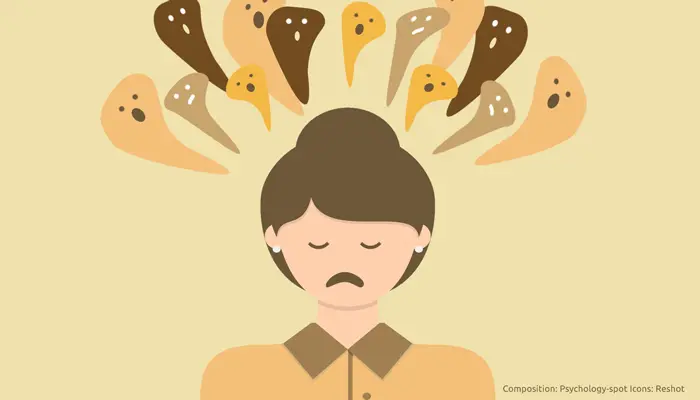
Anxiety is an unpleasant feeling, that’s for sure. However, beyond that feeling of restlessness that sometime assails us, anxiety also hides some very curious effects. Which ones?
1. Anxiety makes the world stinks, literally! Researchers at the University of Wisconsin have realized a very interesting study that evaluated the level of anxiety of some persons and their acuity to discriminate different aromas. Thus it was observed that anxiety did not improve discrimination of good smells but of unpleasant odors. Using functional magnetic resonance imaging, they also observed that anxious people react more intensely to unpleasant odors, compared with those who did not suffer anxiety. At this point there’s no doubt, anxiety makes the world smell worse.
2. Anxiety affects balance. People who experience intense anxiety, often have balance problems, it is common for them to feel dizzy with no apparent reason. Neuroscientists at the University of Pittsburgh, say that everything could be due to the fact that anxiety and balance share some neural circuits. The converging point of this circuit would be the parabrachial nucleus, where both information: the one of the vestibular system and that involving anxiety arrives. So when we are anxious, we can experience dizziness and loss of balance.
3. Anxiety makes us jump straight to conclusions. An interesting experiment conducted at the University of Illinois, showed that anxious people tend to reach conclusions too quickly based on the emotional states of the others. Basically, these researchers introduced to the volunteers a series of images including several faces changing their emotional expressions. Thus, it was observed that anxious people were able to notice before others the change of expression, but were often wrong in identifying it.
Why?
Researchers think that the state of hypervigilance that characterizes anxiety alert them of any changes that occur in the environment, even if small. However, the same state of agitation, would prevent them for taking the necessary time to evaluate what kind of emotion is taking them straight to conclusions.
And finally, it has also been demonstrated that anxious people need more interpersonal space to feel comfortable.
Sources
Krusemark, E. A. & Li, W. (2012) Enhanced Olfactory Sensory Perception of Threat in Anxiety: An Event-Related fMRI Study. Chemosensory Perception; 5(1): 37-45.
Fraley, R. C. et. Al. (2006) Adult Attachment and the Perception of Emotional Expressions: Probing the Hyperactivating Strategies Underlying Anxious Attachment. Journal of Personality; 74(4): 1163–1190.
Baladan, c. D. & Thayer, J. F. (2001) Neurological bases for balance-anxiety links. Journal of Anxiety Disorder; 15(1-2): 53-79.