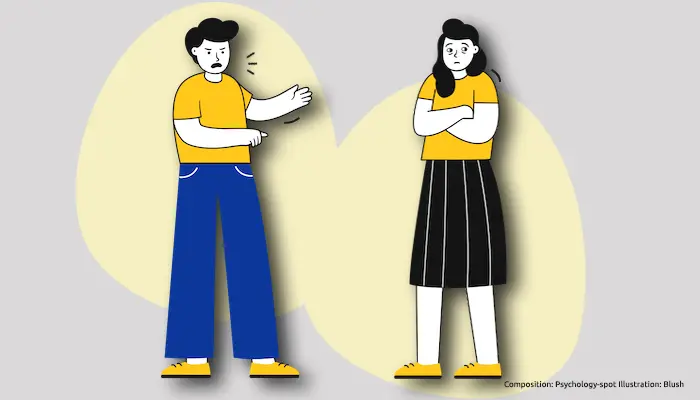
In a relationship, disagreements are as inevitable as the changing seasons. They can arise from something as mundane as choosing weekend plans, dividing household chores, or deciding where to spend Christmas. At other times, differences stem from something deeper, such as differing values, expectations, or ways of expressing affection.
And although we often think that arguments are the prelude to a bigger problem, the truth is that disagreements are normal since, after all, a couple (however much they love each other) is made up of two people with different life histories, worldviews, and personalities. Therefore, it’s not surprising that these worlds sometimes clash.
The good news is that arguments don’t “kill” love. The bad news is that not knowing how to handle them properly can fracture the relationship.
Five practical strategies for addressing relationship problems with maturity
Be empathetic. Learn to compromise. Practice active listening. Don’t let emotions take over. Think before you speak… You’ve probably heard this advice and a thousand other things, but it’s also likely that when things get heated, it falls on deaf ears because it’s too generic. What to do?
These are some practical psychological strategies that you can apply to resolve conflicts and discuss in a mature and productive way.
1. Plan the discussion
Most arguments between couples are spontaneous. This means that one partner gets angry and takes the other by surprise, who immediately becomes defensive. However, these impromptu altercations rarely lead to a solution because they usually begin with a cathartic purpose and end up becoming an exchange of reproaches, criticisms, and recriminations.
To avoid pointless arguments, just as you plan a trip and arrange to meet somewhere, it’s best to agree on a time to address the issues that concern you most. Planning offers two major advantages: firstly, you’ll have time to reflect on the disagreement with a clear head, and secondly, you’ll be calmer, allowing you to express yourselves more clearly.
2. One problem at a time, starting with the smallest ones
In arguments between couples, it’s common for a minor disagreement over a trivial, everyday matter to escalate, dredging up old disappointments and resentments. In a matter of seconds, what started as a simple disagreement about who takes out the trash or takes the child to school transforms into a snowball of bitterness and repressed emotions that rolls uncontrollably downhill. Obviously, this makes finding a solution virtually impossible.
In contrast, researchers at the University of Tennessee observed that happy couples avoided this dynamic and adopted a conflict-solving approach. They also noted that they tended to focus first on the easiest problems to resolve.
This approach is interesting because tackling the most sensitive issues first can sabotage the solution and undermine your trust in the relationship. On the other hand, if you both feel you can work together to resolve the problems, you’ll gain the necessary trust to address more complex conflicts. Therefore, the key is to choose one problem and stick to it.
3. Use “I” and “we” more than “you”
When a conflict arises, it’s common for each person to entrench themselves in their position and launch personal attacks from their “walled tower”: “You always do the same thing,” “You never listen to me,” and so on. However, these kinds of comments destroy the bridges of dialogue because they put the other person on the defensive.
If you start with an accusation, your partner will likely ignore what you’re trying to say, and you won’t reach an agreement. That’s not how you move forward; it just leads to endless arguments. Instead, you could talk about how you feel and what you’d like the relationship to be like.
Replace the typical complaint, “You always forget,” with, “I felt bad because I interpreted that forgetfulness as disrespectful. What could we do to prevent it from happening again?” This way, you’re starting a more productive conversation instead of putting your partner on the defensive. Ultimately, it’s about speaking more from your perspective and expressing what you want for the relationship, keeping in mind that the goal is to resolve the problem, not win the argument.
4. Lower your defenses
At the same time, when you feel attacked, it’s normal to try to defend yourself. If your partner reproaches you, “You never walk the dog!” , you’ll probably reply, “I can’t, I have to work! ” But you usually don’t stop there; your wounded ego continues, “You don’t acknowledge anything I do! “
You might be right, but that’s not the best way to solve a problem. It only creates an uncomfortable tug-of-war where the more defensive you are, the more your partner will move to the other extreme. To break that cycle and regain control, you have to lower your defenses.
A useful technique is the “Reflective Pause.” Stop for 5 or 10 minutes to calm down and prevent the discussion from escalating. Then, it’s a good idea to take responsibility for your part. This will relieve tension, reduce physiological arousal, and show that you don’t want to argue, but rather that you’re genuinely interested in resolving the issue.
5. Look for points of agreement
In relationships, many problems fester. If an argument gets stuck, ideally you should find some common ground, however small. Even in the biggest disagreements, there are always points of convergence. Identifying the things you both agree on helps reduce polarization and allows you to move forward.
It can be as simple as acknowledging each other’s efforts or admitting that you both want the same thing, even if you differ on how to achieve it. Then, it’s a good idea to turn that partial agreement into a small joint action.
It’s about developing micro-commitments, concrete and easy-to-fulfill actions that you can both carry out. For example: “We agree that we want to communicate better. This week, when we argue, we’ll take a two-minute break to breathe before continuing.” These micro-commitments foster a sense of teamwork and strengthen the bond, even in the midst of conflict.
When “talking about it at home” isn’t enough: seek psychological help
Not all relationship conflicts can be resolved “at home,” no matter how much love or goodwill exists.
When an argument becomes a déjà vu, it often reveals that the relationship is stuck in a pattern that both partners unwittingly perpetuate. In such cases, couples therapy becomes a safe and neutral space where each person can express their concerns and feelings.
In fact, an experiment conducted at the University of Geneva confirmed for the first time that while arguments between couples “switch off” the areas of the brain linked to romantic love, mediation keeps them active, helping the members reach a satisfactory agreement while reducing residual conflicts.
A therapist can help you identify the true source of these circular arguments, dismantle the patterns that perpetuate them, and suggest more constructive ways of communicating. With practice and awareness, you can learn to manage your differences so that they don’t drive you apart, but rather become opportunities to get to know each other better and strengthen your bond. Ultimately, a healthy relationship isn’t one that avoids conflict, but one that manages it with respect and emotional intelligence.
References:
Rauer, A. et. Al. (2020) What are the marital problems of happy couples? A multimethod, two‐sample investigation. Family Process; 59(3): 1275–1292.
Rafi, H. et. Al. (2020) Impact of couple conflict and mediation on how romantic partners are seen: An fMRI study. Cortex, 2020; 130: 302-317.
Scheeren, P. et. Al. (2014) Marital Quality and Attachment: The Mediator Role of Conflict Resolution Styles. Paidéia; 24(58): 177-186.




Leave a Reply