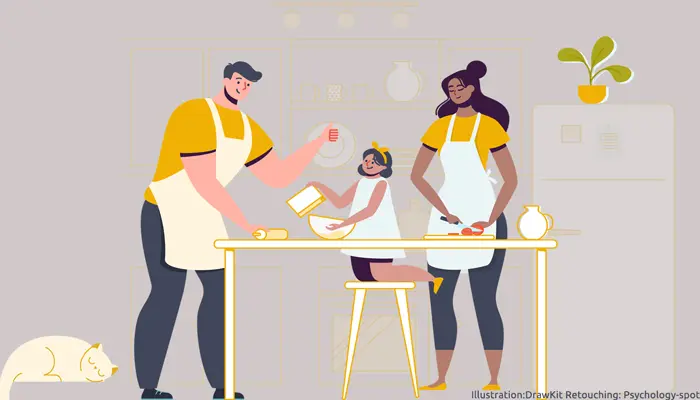
Did you know that Denmark has been the happiest country in the world for several years? The key, or at least part of it, lies in the education children receive from a young age. Danish have implemented a happy parenting style that is repeated generation after generation and allows them to raise strong, emotionally secure, and happy children who later become resilient, confident, and happy adults. What’s their secret?
The factory settings that we have “installed” as parents
“Sometimes we forget that parenting, like loving, is a verb that must be conjugated. It requires effort and work to yield positive results. To be a good parent, you need to be self-aware; to observe what you do when you’re tired, stressed, or when someone pushes you to your limit. This is what we call “factory settings”: the way you react and act automatically when you’re too tired to think.”
“We inherit a large part of our factory settings from our parents. They’re installed in us like the motherboard in a computer. They’re the settings we turn to every time we feel frustrated, and they were installed in our childhood. It’s when we hear ourselves saying things we don’t mean, when we act and react inappropriately, or when we feel bad because deep down we know there are better ways to get good results with our children, but we don’t know how to achieve them. Every parent knows this feeling.”
“That’s why it’s so important to observe your default settings, analyze them, and understand them. What do you like about how you act and react with your children? What don’t you like? Are you repeating a pattern from your childhood? Would you like to change anything? Only when you distinguish your innate attitudes as a parent—that default setting—will you be able to decide how to improve it.”
These are the words of American psychologist Jessica Joelle Alexander and Danish coach and therapist Iben Dissing, who reveal the Danish parenting method step by step in their book “How to Raise Happy Children.”
These are the six keys:
P -lay
A -uthenticity
R -eframing
E -mpathy
N -o ultimatums
T -ogetherness
How to raise children to be truly happy?
- Teach them to play, but for real
In a highly competitive culture, children learn to compete with each other quickly, even before starting school. However, children need to be happy, not to be the best. If children must constantly strive to achieve a goal, get good grades, or earn the recognition of their parents and teachers, they won’t fully enjoy their childhood. They will fall victim to conclusionism, always looking to the future, without learning to enjoy the present. That doesn’t mean they shouldn’t set goals, but there should always be room for play.
Free play is essential, not only in childhood but throughout life. Through play, we discover the pleasure of dedicating ourselves to something without pursuing a specific goal, simply because the activity itself produces enjoyment. Free play allows us to connect with our playful side, fosters a mindful attitude, and stimulates creativity. Therefore, if you want your children to be happy, make sure they don’t have their eyes glued to screens permanently, but rather enjoy free play. Give them space to explore and discover the world on their own. Remember that a happy child should play, make a mess, and get dirty.
- Let them be authentic
Don’t try to mold your children in your image. Every child is unique; take the time to understand their potential, needs, and dreams so you can help them be authentic. Remember that every child must develop their own way of doing things, and your mission is to help them find their own path, not to impose a way of doing or thinking. Encourage them to express their feelings assertively and set their own goals. Teach them to listen to their inner voice and connect with their emotions.
Convey the idea that the most important thing is to focus on individual effort and that they shouldn’t compete with anyone but themselves. It’s important that children don’t feel the need to compare themselves to their siblings or classmates, but rather understand that each person is unique. This way, you’ll be helping them build bulletproof self-esteem. You’ll raise a confident child who knows what they want and strives to achieve it.
- Use redefinition to improve
Danes avoid using limiting and negative language with children because they are aware that these words leave a deep mark on children’s brains. Instead, they try to instill a more positive attitude that helps them cope with difficult life situations.
They don’t tell their children what to do, how they should feel, or how to handle certain situations; instead, they encourage them to analyze problems from different perspectives. They use the mechanism of redefinition to teach them that in life, nothing is completely good or completely bad; it all depends on our perspective.
The only way to maintain healthy and loving relationships over time is to strengthen empathy from an early age. The Danish method for raising happy children understands that without empathy, one can quickly fall into narcissism. Without empathy, children can become little tyrants suffering from Emperor Syndrome, making coexistence at home virtually impossible.
It’s about teaching them to connect with the feelings of others, to understand that their freedom ends where the freedom of others begins, and to respect the ideas of others, even if they don’t agree with them.
- Learn not to give ultimatums
For a child to be happy, they need certain limits and rules that give meaning to their world, but they also need freedom and to have their opinions heard. Danes are aware of the need to develop a more democratic parenting style that fosters self-confidence. Therefore, most families don’t give ultimatums.
Instead of engaging in power struggles, a more respectful upbringing is developed, where children’s opinions, needs, and desires are taken into account. It’s about educating from a place of closeness, not fear or imposition. This doesn’t mean spoiling them, but rather teaching them to assert their rights and understanding from a young age that all opinions are equally important, even though they won’t always be right or what they want will be done. The motto is: teach children to respect, and respect them, and you will earn respect. It’s simple.
- Reinforces hygge
In Denmark, winters are often cold and windy, with few hours of daylight, so people spend a lot of time indoors. For this reason, hygge takes on special relevance, a Danish concept that means spending time with loved ones in a comfortable, intimate, and pleasant environment. The word hygge also indicates an intense feeling of well-being that involves feeling at peace with those close to you and being able to enjoy a charming place.
This concept is key to children growing up happy, as it instills in them the importance of spending quality time with those close to them, emphasizing the importance of building strong bonds. However, it also teaches them to enjoy their surroundings and ensure that they are pleasant and welcoming for everyone.
Reference:
Joelle, J. & Dissing, I. (2017) Cómo criar niños felices. El método danés para desarrollar la autoestima y el talento de nuestros hijos. Barcelona: Editorial Planeta.