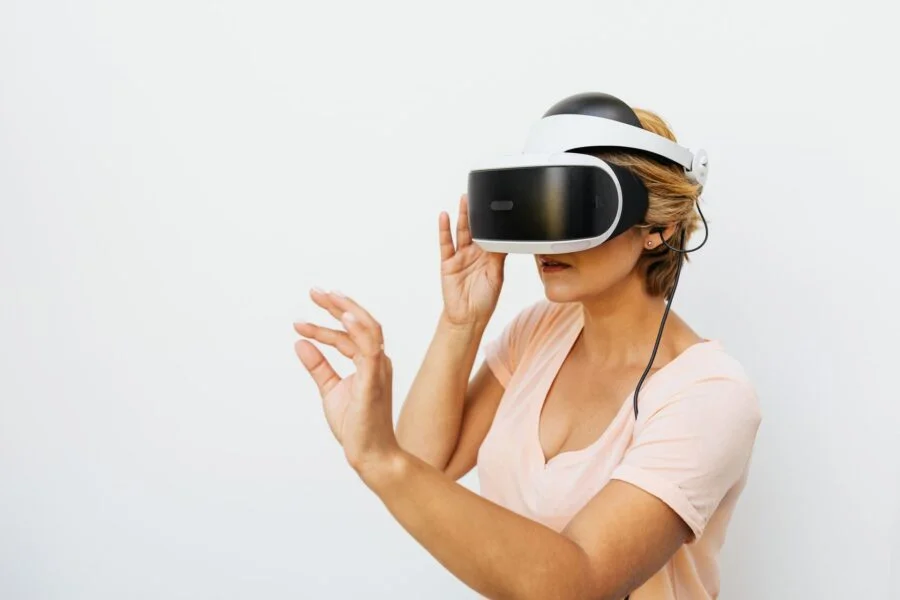
There are things a person can explain about themselves, and others that are revealed only when they have to solve a problem. Someone might say they are easily distracted, struggle with organization, tend to act impulsively, or have become more forgetful lately; however, neuropsychological assessment goes a step further by attempting to understand what is happening inside that person’s brain.
For decades, capabilities such as attention, memory, thought, and language were evaluated using structured tasks, questionnaires, and neuropsychological tests. While undoubtedly valuable, these tools present a significant challenge: there is a difference between solving a task specifically designed to measure a function and navigating a similar situation in everyday life.
This is where virtual reality (VR) is opening up a new avenue for neuropsychological assessment. By creating immersive, interactive, three-dimensional scenarios, it places the individual in situations that more closely resemble those where they use their cognitive abilities in daily life, while simultaneously objectively recording their responses.
Observing Behavior in Action within more Complex Environments
Executive functions are not isolated skills; they work together to direct our behavior toward a goal. They help us plan our actions, keep relevant information in mind, inhibit automatic responses, devise and switch strategies when necessary, and make decisions among various alternatives.
The challenge lies in the fact that many of these capabilities manifest differently depending on the context. In a conventional neuropsychological test, for instance, a person might receive a specific instruction and focus on completing it for a few minutes. In contrast, the demands of daily life are often intertwined: we must remember something while performing another task, constantly ignore distractions, decide what to do first, and adjust our plans when unexpected issues arise.
Virtual reality better replicates this complexity. For example, the “Ice Cream” executive function test – part of the virtual reality neuropsychological assessment by Nesplora – places the individual in a virtual scenario where they must navigate the experience as if it were their first day working in an ice cream parlor. This situation presents various cognitive demands that allow for the observation of how a person plans, retains, and updates information, switches between tasks, or regulates their responses.
Greater Ecological Validity
Ecological validity refers to the extent to which test results can be applied and generalized to real-life situations. A completely decontextualized test may be excellent for measuring a specific cognitive process; however, if the goal is to understand how a person functions in daily life – such as when planning multiple actions, remembering information while performing a task, or adapting to emerging changes – placing them in a more dynamic scenario offers a more realistic perspective.
VR enables the simulation of such an environment, providing a fully immersive user experience with a high degree of realism. It allows for the design of specific stimuli, distractions, and demands under standardized conditions, while the patient interacts with a three-dimensional space that closely resembles real-world situations. This combination of experimental control and realism is precisely one of its major advantages.
A Window into what Usually Remains Hidden
Virtual reality tests also record what occurs while the individual interacts with the environment. Whether the task involves picking up specific virtual objects, remembering instructions, attending to various elements, or working toward a specific goal, the system tracks variables such as time spent, response accuracy, the number and type of errors made, and aspects related to planning efficiency.
Consequently, the outcome is not limited to whether the answer was correct or incorrect; the information provided by these tests is far more comprehensive, offering insight into how the person arrived at a response or identifying which step might have failed along the way.
For instance, a person might ultimately achieve the goal but use an inefficient strategy, make numerous errors before correcting them, or require more time to reorganize when conditions change. These differences can be clinically significant because they provide information about the underlying cognitive process, rather than just the final result.
Reduced Evaluator Bias
In any psychological assessment, the interaction between the professional and the patient is part of the process. Instructions, context, and clinical interpretation are necessary elements, but they can also introduce a certain degree of variability, as the evaluator’s biases, expectations, or even subtle unconscious cues can creep in.
Virtual reality allows for the standardization of a substantial part of that experience. Each person encounters the same scenario, the same stimuli, and the same assessment conditions. Furthermore, many variables are recorded automatically, reducing the need for the professional to intervene and subjectively evaluate every response in real time.
Of course, this does not mean that technology replaces the psychologist or completely eliminates all bias. Clinical interpretation remains essential; what changes is that the professional has access to a greater amount of objective, standardized data regarding behavior and executive functions. In other words, VR does not eliminate the clinical perspective but rather provides a more precise view of what is occurring.
From a Still Photograph to a Movie of Cognitive Functioning
Traditional neuropsychological assessment continues to play an essential role; virtual reality does not aim to replace all existing tools but rather to expand observational capacity by providing a more faithful “movie” of cognitive functioning – as opposed to a still photograph – while adding speed, reliability, and diagnostic precision.
Nesplora, for example, integrates this approach into an assessment platform that includes virtual reality-based tests for attention, memory, and executive functions. In the adult memory test, the setting is a furniture store where the individual must recall various orders, combining visual and auditory stimuli just as in real life.
To assess attention in children, for instance, the scenario resembles a school or high school classroom; the perspective places the examinee at a desk facing the blackboard but introduces common distractions, such as a car passing by outside, a classmate calling out to the child, or a knock on the door.
These tests provide detailed information that helps professionals better understand each case, make more accurate diagnoses, and design appropriate intervention strategies.
In fact, a systematic review of 100 studies concluded that “available virtual reality-based tools appear to be promising solutions for the ecological assessment and treatment of executive dysfunction in healthy individuals and various clinical populations”; however, it is important to clarify that this does not mean their use alone guarantees greater diagnostic accuracy, as the role of the neuropsychologist remains essential.
Ultimately, understanding the mind is not just about knowing whether a response is correct or not; it is also necessary to understand how that answer is reached. And when technology allows us to observe that process in greater detail, neuropsychological assessment can move a little closer to what truly matters: understanding how a person thinks, decides, and acts when navigating the real world.
Sources:
Kirkham, R.et. Al. (2024) Immersive Virtual Reality-Based Methods for Assessing Executive Functioning: Systematic Review. JMIR Serious Games;12:e50282.
Borgnis, F. et. Al. (2022) Available Virtual Reality-Based Tools for Executive Functions: A Systematic Review. Front Psychol;13:833136.




Leave a Reply