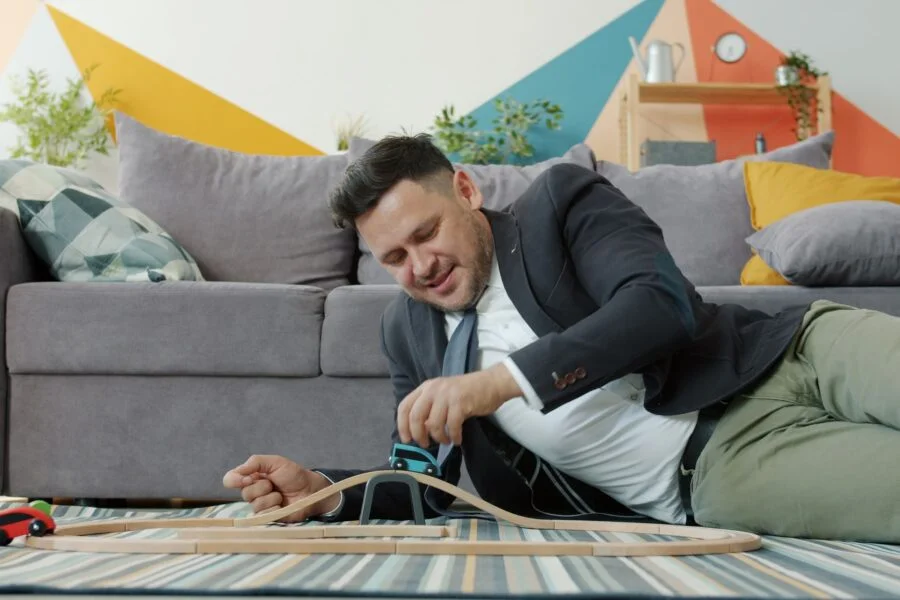
Lately, I’ve noticed something curious about society’s relationship with adulthood: we want all its advantages, but we’re not always willing to accept its drawbacks. We want to make decisions about our lives, have our preferences respected, have the freedom to do whatever we want, and not have anyone tell us how to behave. However, as soon as things go wrong, we expect someone (perhaps a genie in a lamp?) to appear and solve the problem, right the wrong, or at the very least, reaffirm our belief that we shouldn’t be going through such a hardship.
Many adults work and are even parents, yet they react to a “no” as if someone had just stolen their favorite toy. Social infantilization is advancing by leaps and bounds, driven by apps that seem to streamline everything, governments that restrict our ability to choose our future, and an increasingly pre-digested social debate where there are no middle grounds or room for the essential “I don’t know” that encourages us to carefully consider our position.
Believing that we deserve for everything to go well
One of the peculiarities of today’s society is that we have raised our expectations of satisfaction to levels that are difficult to sustain. We don’t simply want to enjoy things; we expect them to work, to be available, to arrive promptly, to meet our preferences, and to do so without requiring too much effort from us.
We’ve gone from considering certain comforts that were once privileges to taking them for granted. If a service fails, we’re outraged. If something takes more than a millisecond, we despair. If someone doesn’t respond immediately to a message, we lash out at them. If a plan changes, we struggle to accept that someone might have other priorities. And if we receive criticism, we don’t always ask ourselves if it contains any truth, but rather how someone dared to question us.
Behind these reactions often lies an unrealistic psychological expectation, more characteristic of children than adults: the idea that the world should adapt to our needs. The problem is that reality has no obligation to do so. Life is unfair. People have their own interests, circumstances are unpredictable, and our desires constantly compete with those of others. And all of that is normal. Even if we don’t want to accept it.
The Stoic philosopher Epictetus already called for a distinction between what depends on us and what is beyond our control. Two thousand years later, we still struggle to accept this rather basic distinction. We insist on controlling everything, as if life were a customer service department we could complain to when something doesn’t meet our expectations. Spoiler alert: it doesn’t work that way.
Frustration, an experience that should not be extinguished
Frustration tolerance is one of the most important skills developed in childhood. A child gradually learns that they can’t have everything they want, that they must wait their turn, that limits exist, and that “no” is part of living together. They don’t learn this through a PowerPoint presentation, but rather by repeatedly encountering situations that force them to regulate their impulses and recalibrate their expectations.
That learning doesn’t end when you turn eighteen. Psychological maturity requires continued practice. However, it seems that lately we’ve developed a certain aversion to experiences that force us to do so.
In fact, the infantilization of society stems largely from this desire to eliminate discomfort. And it’s not a phenomenon limited to childhood; everything is increasingly geared toward treating adults as if they have less autonomy, tolerance for discomfort, and intelligence, making decisions for them or removing discomfort before they discover what they can do about it.
This mechanism also extends to the social sphere. Institutions, services, and technology are increasingly taking on tasks that previously required a certain level of initiative, judgment, or tolerance on our part. When that space to deal with discomfort or simply the unexpected disappears, any setback can escalate into a crisis. And, naturally, there will always be someone ready to agree with us and claim it’s the fault of the delivery person, our colleague, our partner, the government, or Mercury retrograde.
Responsibility, the less attractive side of freedom
Infantilization also manifests itself in our relationship with responsibility. We like to champion individual freedom, but we don’t always accept that making decisions involves giving up other possibilities and bearing the consequences. We want to choose without making mistakes, act without taking risks, and obtain results without going through the process that makes them possible.
From a philosophical perspective, this presents an interesting contradiction. Jean-Paul Sartre argued that we are condemned to be free because even when we avoid making a decision, we are still making one. However, freedom doesn’t consist solely of being able to do what we want, but rather of taking responsibility for our choices.
Growing up means abandoning the fantasy that we can have it all or that there’s a solution where we keep all the advantages, avoid all the costs, and no one ends up disappointed. In the vast majority of cases, we have to choose, lose something, and move on. It’s not an injustice of the universe; it’s part of the contract of life. Every choice involves a sacrifice and a responsibility.
Growing up means letting go of the idea that we are the center of everything
Childhood has a wonderful characteristic: the world is discovered from an inevitably egocentric perspective. Children still need to learn that others have their own desires, needs, and concerns, independent of their own. In fact, a fundamental part of development involves broadening this perspective and understanding that we are not the permanent center of others’ experiences.
Adulthood should solidify that learning, so that the true indicator of maturity isn’t how much we know or how much we earn, but what we do when reality contradicts our plans. If we can listen without feeling threatened, accept a refusal without seeking retaliation, acknowledge a mistake without constructing a three-volume defense, or accept that we aren’t always right and that’s okay, we’re on the right track.
And, unfortunately (or fortunately), there is still no app that can do it for us.




Leave a Reply