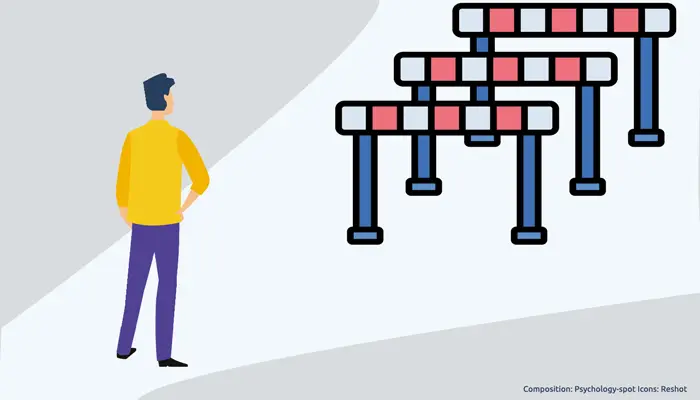
Life throws obstacles in our path, surprises us with unexpected twists and turns, and erects walls we didn’t ask for. No one is exempt from difficulties. But often, overwhelmed by the weight of our problems, we don’t realize that it’s not the obstacles that stop us, but the way we perceive them. What paralyzes us is not the barrier itself, but the way we face it. In other words, life throws obstacles your way, but you set the limits.
An obstacle is not the same as a limit
First, let’s clarify concepts. An obstacle is an impediment. In fact, the word was originally used only to refer to a situation we must face, without adding a negative connotation. This means that an obstacle isn’t necessarily something that limits us.
The limit is the barrier we establish in response to that obstacle. While the obstacle is the objective situation, the limit is closer to a belief.
For example, a lack of resources can be an obstacle to embarking on a professional project, but thinking “I can’t do it” or “it’s not worth trying” is a limit we set for ourselves in response to that obstacle. Obviously, a lack of resources can make things very difficult for us, but it doesn’t mean we should throw in the towel or that there aren’t alternative ways to achieve what we want.
The problem is that in life we often confuse the two. When we feel emotionally overwhelmed, we assume that if there’s an obstacle, there’s no way out. We believe that if something is difficult, it’s no longer worth trying. And without realizing it, we retreat without having put up a fight. Not because we can’t go on, but because we convince ourselves that we can’t go on.
How are limits made?
Losing a job, getting sick, failing a work project, being told “no” on something important, not having enough resources… All of these are obstacles. They’re very real. They’re objective. And denying them would be irresponsible.
But they are also part of the growth process. Life, by its nature, does not flow without resistance. The important thing is not to avoid obstacles, but to be aware of how we perceive, interpret, and deal with them.
Some people, when faced with a setback, reorganize their path. Others, on the other hand, stop and build an internal wall, telling themselves, “I’m not good at this,” “I can’t,” or “It’s too late for me.” Then the external obstacle becomes a self-imposed limit.
In fact, self-imposed limits don’t arise out of nowhere; they are often built from the building blocks of past experiences, inherited beliefs, and fears.
- Unprocessed negative experiences. Past failures, rejections, or traumatic situations that we haven’t fully processed can trigger an anticipatory avoidance reaction. It’s as if the brain activates defense mode and says, “I’d better not try, so it won’t hurt again.”
- Limiting beliefs learned in childhood. Comments like “You’re not good enough,” “That’s not for you,” or “Better play it safe” sink in deeply and become entrenched truths we don’t question. These phrases, repeated constantly, eventually become self-imposed limits.
- Fragile self-confidence. When we underestimate our abilities, any challenge is perceived as something disproportionate that we won’t be able to overcome. Then doubts and fears arise. We ask ourselves, “What if I’m not up to it?” And we end up giving up even before testing ourselves.
- Excessive self-demand. Interestingly, perfectionism is also limiting. When you think that if you can’t do it perfectly, you’d better not even try, you’re holding yourself back. Demanding too much of yourself when faced with an obstacle can add excessive pressure that ends up paralyzing you.
What happens when we confuse obstacles with limits?
The most common consequence is that we stop too soon. We give up without having tried everything. This can lead to a life of feeling like we’re always halfway there, whether in projects, relationships, or decisions.
On a psychological level, this creates a state of frustration and a feeling of stagnation in life. We treat ourselves as if we’re incapable of overcoming the obstacle, when in reality we’re just paralyzed by the mental limits we’ve imposed on ourselves.
The curious thing is that the more we allow these obstacles to define us, the more we reinforce the belief that we can’t overcome them. And the stronger that belief becomes, the more limits we impose on ourselves. It’s a vicious cycle that feeds on itself.
How to stop turning obstacles into limits
It’s not about ignoring difficulties or pretending they don’t exist by assuming a hopeless optimism, but rather about facing them without giving them complete control over our lives. It’s about understanding that an obstacle can be overcome in many ways because there’s no single path to achieving our goals.
1. Change the question: go from “can I?” to “how?”
When something gets complicated, it’s normal for the first question that comes to mind to be: Can I do this? However, if you’re truly motivated to go in that direction, you should change your focus. Don’t question whether you can do it or not, as that will only fuel doubts. Take a proactive attitude and ask yourself how you could achieve it. Moving from “I can’t do it” to “What do I have to do to achieve this?” opens up new mental pathways. You may have to take a detour you hadn’t planned, it may take longer than you thought, or you may have to put in more effort, but the important thing is that you achieve it.
2. Detect your internal limits
Avoid deceiving yourself. Is what’s holding you back an immovable obstacle or a mental limit? You can take a pen and paper to write down the phrases you use to sabotage yourself. For example: “I’m not good at public speaking,” “I never finish what I start,” or “I’m not cut out for this.” Once you’ve identified them, ask yourself:
- Who taught me this?
- What objective evidence do I have that this is true?
- What if you proved me wrong, even just once?
3. Make it a beta version
We often hope for time, motivation, or the perfect conditions to act. But that rarely happens – or if it does, it doesn’t all happen at once. So, move forward with what you have. Don’t wait until everything is clear, perfect, or under control to begin. Take steps in a “prototype” version. Launch the project with what you have. Talk even if you feel nervous. Progress doesn’t come after confidence; often, confidence comes precisely with progress. Taking the plunge is the best way to see whether you can achieve it or not.
4. Redefine your relationship with error
Mistakes aren’t proof that you failed. They’re evidence that you tried. Changing that mindset will allow you to face obstacles with less stress. If something doesn’t go well, what useful lesson can you learn? People who progress aren’t those who never fail, but those who are able to quickly adjust their plan to adapt to life’s changing conditions.
5. Look for role models that inspire you
Comparing yourself to people who are a thousand steps ahead of you can paralyze you, but only if you focus on the distance that separates you from them. Instead, if you see them as proof that it’s possible to achieve something, they become the impetus you need to keep going. Analyze what they did, what they failed at, and what obstacles they overcame. There are many examples of resilience and success all around you. You just have to open your eyes and learn to use them as a source of motivation and inspiration.
Ultimately, obstacles exist, and we will have to deal with many of them throughout life. But most of the time, we set the limits ourselves. If you can’t jump over a wall, go around it. If you can’t swim across an ocean, build a boat.
It’s not about denying what’s difficult. It’s about not betraying yourself. About not giving up on your dreams just because they’re more complicated than you initially thought. So, the next time you tell yourself ” I can’t, ” take a strategic pause and ask yourself honestly: Is this a real obstacle… or an internal limit I’m reinforcing?




Leave a Reply