Updated: 14/12/2023 por Jennifer Delgado | Published: 22/06/2018
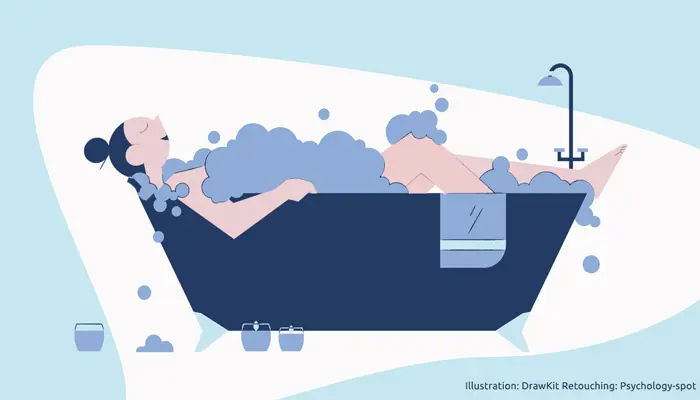
To sing in the shower is not necessary to have the voice of Whitney Houston or Freddy Mercury, it is equally beneficial. In fact, it is even likely that you realized that your voice sounds better, which is because the acoustics in the bathroom is just perfect to host a small private concert.
The tiles on the walls do not absorb the sound, which means that your voice bounces before going off completely. It is estimated that in the bathroom, the sound waves can vibrate about 100 times per second. Therefore, you can listen to your voice longer than in a normal room.
In addition, since bathrooms are usually small spaces, the voice acquires a deeper sound and improve the bass tones, so it sounds more powerful. That communion of factors is what makes your voice better enough while you sing in the shower. However, the most interesting are not the sound effects that can feed your ego making you believe that you are a good singer, but the incredible advantages at the psychological level of that simple act.
Singing in the shower improve your mood
It does not matter if you sing in the shower early in the morning before going to work, or when you come home at night, in any case the music can improve your mood. When you sing, your brain releases endorphins, neurotransmitters linked to relaxation that also reduce the perception of pain.
Singing also promotes the release of dopamine, a neurotransmitter that generates a pleasant sensation of pleasure and satisfaction. The key is that music acts directly on the limbic system, especially on the amygdala, the structure responsible for processing emotions. Therefore, singing is an excellent strategy to circumvent the control of the prefrontal lobes that keep us worried and in tension, in order to alleviate tensions and stress, reaching a state of relaxation.
It decreases the level of cortisol, the stress hormone
A recent study conducted at Tsurumi University revealed that singing is a perfect activity to synchronize vegetative functions such as blood pressure, respiration and heart rate. These researchers asked the participants to sing three songs in a row, for just 3 minutes.
After that time, they again measured their vital signs, taking samples of saliva and blood. They discovered that there was a decrease in blood pressure and heart rate, pacing with breathing. In addition, they showed lower levels of cortisol in their blood, the stress hormone. Those persons also reported feeling more comfortable and relaxed.
It facilitates deep breathing by emptying the mind of worries
Breathing is a key function that we tend to neglect. Normally we breathe superficially and choppy, which does not facilitate oxygenation. When singing that process is reversed, we usually breathe deeply, which improves oxygenation at all levels in the organism.
When we add the effect of water, which has a revitalizing action, we can understand why a shower can become so regenerative. In fact, some researchers have come to equate the psychological and physical benefits of the act of singing under the shower with the effects of meditation. It is not strange, because when we sing in an environment where we feel comfortable and we know that nobody is going to judge us, we simply enjoy it and empty our mind of worries.
Sources:
Sakano, K. et. Al. (2014) Possible benefits of singing to the mental and physical condition of the elderly. Biopsychosoc Med; 8: 11.
Dunbar, R. et. Al. (2012) Performance of music elevates pain threshold and positive affect: implications for the evolutionary function of music. Evol Psychol;10(4): 688-702.