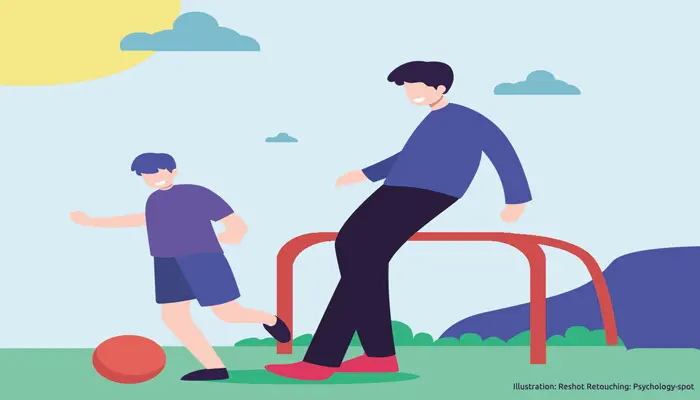
Often we, the adults, claim that children stay calm, patient, use their imagination to entertain themselves and stay clean even when they play outdoors.
But this is not childhood. Children need to move, explore, live adventures, discovering new worlds … And while they do it is normal they get agitated and dirty. In fact, it is not something negative or pathological, is synonymous of a healthy and happy child.
Getting dirty is fun and stimulates learning
When adults see a child with his hands and clothes full of dirt or food, they think it should not behave like that and maybe ask themselves: “How do the parents allow their son to do something like that? Didn’t they taught him the good manners!”
Most people do not even think that child is exploring and learning, that is experiencing the world around him through his senses. They do not think that children do not learn just looking but also by touching and smelling, and that learning is one of the most enriching experiences they can live in their childhood.
When children have the opportunity to play with water, sand, dirt, paint, gelatin or flour, they learn through touch, and what they feel is very pleasant since everything is an exciting discovery that stimulates their neural connections.
Let them get dirty allows they experiment with different materials and substances. These games, in which there are no rules and no one “right” way to play, stimulate the natural curiosity of children and help them develop a more open attitude towards the experience.
In fact, a study conducted at the De Montfort University has revealed that children who are allowed to play with food develop a more open attitude to new flavors, and at the end follow a more varied diet.
In addition, psychologists at the University of Iowa have also found that “playing” with food has a positive effect on learning. These researchers examined 72 children and found that at the age of 16 months, children who were allowed to touch, smell and even throwing foods learned before others the words and properties connected to those foodstuffs.
In fact, it was observed that small children can quite easily identify solid objects, for example a cup or an apple, because the size and shape do not vary. However, the liquids and pasty or sticky substances are more difficult to identify. But when children were allowed to play with these substances, learned to recognize and name them before others.
Therefore, let the kids get dirty is not only fun for them and promotes a more open attitude to life, but also improves learning.
Children who grow up in cleaner environments get sick more easily
Playing with mud, sand, dirt and animals is not only useful for the cognitive and emotional development of children, but it is also healthy. Scientists have shown that the phrase all grandmothers used to say: “let them eat mud to develop the defenses” is correct, while the excessive hygiene is bad.
Of course, parents don’t want their children to get sick, but spending a few more minutes with paint stained clothes, dirty shoes or the hands full of dough is not the end of the world. On the contrary, it is likely that children feel happier and their immune system is activated.
In fact, it is not surprising that autoimmune diseases have increased exponentially in recent years, allergies and other diseases related to the immune system, particularly in Western countries.
Scientists wonder if these problems arise because children are no longer exposed to many pathogens, so that the immune system is not fully mature and become hyper-responsive.
This theory is known as the “hygiene hypothesis”, and says that growing up in too clean environments, such as in the cities where there is no domestic animal, and very few microorganisms, interferes with the maturation of the natural defense mechanisms, increasing the risk of getting sick. Now, a study by an international team of scientists has confirmed this hypothesis.
These researchers analyzed the gut microbiota; i.e., communities of microorganisms living in the digestive tract of 222 children who were born and live in Finland, Estonia (where the immune system diseases are frequent early onset) and Karelia (a republic of the Russian Federation, where problems related to the immune system are less common).
The scientists analyzed the eating habits, health and habits of these children during their first 36 months of life. It was discovered that in the microbiota of children of Finland and Estonia predominated bacteroides, while Russian children showed more bifid bacteria.
The researchers say that the presence of Bacteroides in the human digestive tract is a recent phenomenon, linked to the Western way of life, and that these bacteria, instead of activating the immune response, reduce it. In fact, it was found that the microbiota composed mostly by bacteroides was more “quiet”, that is, less active by the immune point of view.
Therefore, the excess of hygiene, aimed at protecting children, actually has the opposite effect and causes they get sick more often, promoting the emergence of diseases that can accompany them for the rest of their lives.
Demanding children and limits for playing
It is worth mentioning that to some children may be unpleasant the contact with some substances. For example, some children may feel uncomfortable to touch mud or sand. You should not force them, but leave them explore at their own pace and choose the way they prefer to play.
Of course, you should not fall in the excess of exposing children to unnecessary risk or let them sully the house whenever they wish. You can set time and place for such games.
The most important thing for parents is to understand that letting children run free and explore the environment, is healthy for their mental and physical development. We should not imprison children in the adult world, but promote their free play, their ability to get surprised and leave them free to explore their environment through the five senses, if they wish.
Sources:
Vatanen, T. et. Al. (2016) Variation in Microbiome LPS Immunogenicity Contributes to Autoimmunity in Humans. Cell; 165(4): 842–853.
Coulthard, H. et. Al. (2015) Enjoyment of tactile play is associated with lower food neophobia in preschool children. J Acad Nutr Diet; 115(7):1134-1140.
Perry, L. K. et. Al. (2014) Highchair philosophers: the impact of seating context-dependent exploration on children’s naming biases. Developmental Science; 17(5): 757-765.