Self-care has become a kind of contemporary mantra. From Instagram posts to mindfulness workshops and coaching sessions, we are constantly told that we must dedicate time to ourselves, meditate, exercise, eat healthily, and practice gratitude.
The message is positive, beautiful, and even Instagrammable… But what happens when, despite all that effort, we still feel exhausted, anxious, or emotionally drained? Perhaps it’s time to question that narrative because the truth is that taking care of yourself isn’t always enough to survive in an environment that destroys you.
The trap of turning self-care into a panacea
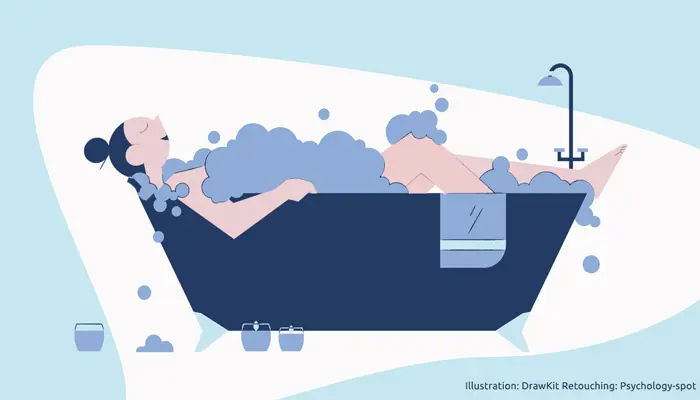
Self-care, as it’s marketed to us, often comes wrapped in a layer of naive romanticism. It’s presented as an almost magical solution to any ailment. But this silent pressure to take care of oneself also implicitly conveys another message: if you’re not well, it’s your fault for not taking a relaxing bath, not lighting the right scented candle, or skipping your journaling session.
Viewing self-care as the solution to all ills, stresses, and worries also implicitly imposes the need to adapt by changing something within ourselves. And this idea can end up generating a perverse effect: we feel like failures for not taking proper care of ourselves and blame ourselves for not being flexible or resilient enough to withstand everything that happens.
But sometimes, we cannot – nor should we – endure everything that happens.
In fact, one of the most common mistakes when talking about self-care is assuming that the responsibility for well-being lies solely with oneself. Of course, we should take care of ourselves, but that doesn’t mean that this approach is a solution to everything.
In practice, this idea can even lead to “self-care overload”: we sign up for yoga classes, meditate, cook healthy recipes, but still don’t feel relieved. This phenomenon, which we often interpret as a personal failure, could actually be a sign that our environment requires deeper intervention.
Because the problem isn’t always within us; sometimes it’s outside.
And in that case, it doesn’t matter how much attention you pay to your well-being if your environment subjects you to constant stress, emotional abuse, or toxic work dynamics. Taking care of yourself is helpful, but only up to a point. When you’re in an unhealthy environment, traditional self-care becomes a band-aid, an illusion of control over something that’s actually beyond your reach. Because all the self-care in the world can’t replace the need to live in a healthy environment.
When taking care of yourself isn’t enough, the environment becomes a determining factor
Imagine you work in a department where everything is rushed, pressured, and met with impossible expectations. You do your mindfulness exercises every morning, eat healthily, and express your emotions promptly in your journal, but when you arrive at the office, you feel a tightness in your chest and your mind is racing.
According to the “job demand and resources theory” of psychologists A. Bakker and E. Demerouti, it is not surprising that when job demands (i.e., never-ending projects, impossible deadlines, demanding bosses, or colleagues who only criticize) exceed available resources (social support, autonomy, and recognition), they generate burnout, regardless of personal coping skills.
The same applies to personal relationships. Gottman’s research on couple dynamics and Bowlby’s research on dysfunctional families show that remaining in an environment that constantly invalidates your emotions or manipulates you can lead to anxiety, depression, and profound emotional exhaustion.
In these cases, self-care becomes an exercise in emotional resilience, but it doesn’t address the root of the problem: the environment itself. Therefore, the true act of self-care might not be on the yoga mat, but rather in rethinking your environment: seeking support, negotiating changes, or, if there’s no other option, distancing yourself from what’s destroying you.
Psychological strategies to go beyond self-care
Changing your environment isn’t always easy, much less immediate. It often involves making painful decisions, such as leaving a well-paying but highly stressful job, distancing yourself from friends or family who only know how to criticize and manipulate, or even ending a toxic relationship.
Several studies on resilience and mental health have shown that people who manage to modify their environment to reduce exposure to chronic stress often experience significant improvements in their well-being, self-esteem, and overall health.
A study conducted at Columbia University, for example, found that when families moved out of impoverished environments, parents reported less distress and children reported less anxiety or depression. Similarly, reducing work demands can significantly lower stress.
It has also been observed that, in the workplace, diverting attention from stressful experiences can reduce symptoms in the short term, but not in the long term. In other words, for a truly significant reduction in stress to occur, it is necessary to balance work demands and provide social support. Simply taking care of oneself or changing one’s mindset is not enough.
With this in mind, if stress, emotional exhaustion, or irritability have recently become your default states, it’s important to take care of yourself and pay attention to your needs, but you should also:
- Evaluate your environment objectively. Take stock of the spaces you occupy daily and ask yourself: Does this place nourish me or drain me? Do the relationships I maintain support me or deplete me? Self-awareness is the first step in deciding whether a deeper change is necessary.
- Set clear boundaries. You may not have to leave the environment entirely, but you do need to learn to protect your emotional energy. This could mean saying “no” more often, limiting your exposure to difficult people, or setting strict work schedules. Boundaries not only preserve your well-being, but they can also be helpful in preparing for more significant changes.
- Plan your transition. Changing your environment requires a minimum of planning. For example, if your job is toxic, you can prepare a job search plan or seek additional training. If a family relationship is harmful, limit contact and seek support from others. It’s about thinking about the small steps you need to take so that the change doesn’t overwhelm you.
The courage to prioritize your well-being
Many people feel guilty at the mere thought of moving away from family or partners, or giving up a stable job, but remaining in harmful environments prolongs stress and increases the risk of developing physical and mental problems.
Leaving an environment that destroys us is an act of emotional survival and a responsibility to ourselves. Taking care of yourself is important. Changing your attitude and mindset is also important – and that needs to be clear. But you can’t do that in a context that constantly undermines every step you take.
References:
Tamminga, SJ et. Al. (2023) Individual-level interventions for reducing occupational stress in healthcare workers. Cochrane Database Syst Rev; 5(5): CD002892.
Bakker, AB, & Demerouti, E. (2008) Towards a model of work engagement. The Career Development International; 13(3): 209–223.
Leventhal, T. & Brooks-Gunn, J. (2003) Moving to opportunity: an experimental study of neighborhood effects on mental health. Am J Public Health; 93(9): 1576-1582.
Luthar, S.S.; Cicchetti, D. & Becker, B. (2000) The construct of resilience: A critical evaluation and guidelines for future work. Child Development; 71(3): 543–562.
Gottman, J. & Silver, N. (1999) The seven principles for making marriage work. Three Rivers Press.
Bowlby, J. (1988) A secure base: Parent-child attachment and healthy human development. Basic Books.




Leave a Reply