We all have multiple layers. As if it were an onion, the psychological contents overlap, creating different levels that define us as a person. In our interactions, we decide – more or less consciously – how much of that information to reveal and to what extent. If we feel comfortable and trust the person, we will be more open. If we have just met them and we are still suspicious, we will be more cautious.
The theory of social penetration explains how this exchange of information works, describing the transition from a superficial relationship to a more intimate bond. And the same applies to couple and family relationships as well as to the friendships or social groups to which we belong, as well as to the work interactions we engage in.
The onion model or theory is a useful metaphor to describe how this process of social compenetration works, showing how we relate to each other until our essence is revealed, in addition to giving us some clues to improve our relationships.
The different layers of the people in their relationships
Communication not only allows us to share experiences and establish relationships, but it is also a way to get to know ourselves and others. But it takes time and effort. We don’t get to know someone in a month or even a year because we have to reveal their different psychological layers one by one. The theory of social penetration refers precisely to the existence of several layers, from the most superficial to the deepest.
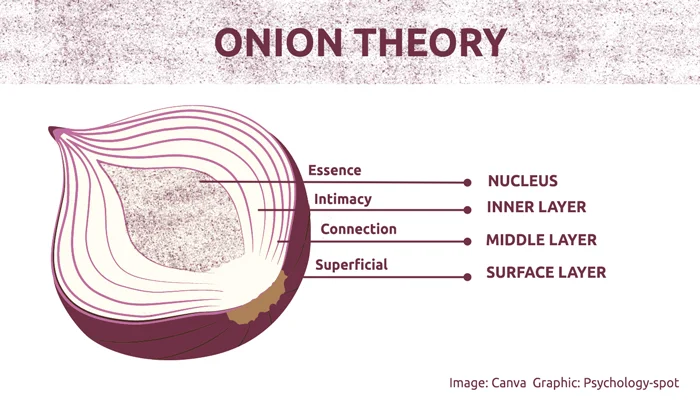
- External layers. It is the public image we project, what we want to be visible to others and the basis on which first impressions are formed. It is the most superficial information that we let on and share with others, often with the intention of showing our best side. These are basic data and general tastes on topics such as music or certain hobbies. Since these are not sensitive issues nor do they involve us emotionally, we share that information relatively easily, although it generally keeps us in a zone of superficial contact.
- Intermediate layers. This involves more personal information, such as religious or political opinions and beliefs, social attitudes, and some past experiences. To open these layers we demand a higher level of trust and they generally only come to light when we feel relatively comfortable with the person and we think that we can emotionally tune in with them, that they will be able to understand us and that they could share some of our values. In a way, when we share this type of information, what we are doing is exploring whether the relationship is worth it and we can go one step further.
- Internal layers. They are deep layers that contain very intimate aspects of our personality, including fears, insecurities, hopes, desires and goals in life. Generally we only share this information with people we trust since in many cases it involves recognizing our vulnerability by exposing our emotional sphere, what really motivates and moves us.
- Core. It is the epicenter of our identity, where the unconfessed desires, drives, the most hidden impulses, the most secret fantasies and the deepest experiences that have changed us lie. On many occasions, we keep that information to ourselves, avoiding sharing it, unless we find someone truly special who we trust, with whom we feel comfortable and who we sense will not judge us. In life, few people can access the psychological core of others, simply because it involves completely stripping themselves emotionally.
How to go from the surface to the essence through self-revelation?
For relationships to develop and consolidate, it is necessary for both people to share information about themselves. The number of topics, their breadth and depth will define the type of relationship and will contribute to creating a certain degree of intimacy.
- Amplitude. It covers the number of topics that can be discussed with one person, from talking about the weather to our craziest hobbies or dreams. The more topics we can talk about with someone, the more likely it is that that relationship will continue to advance and strengthen.
- Depth. It implies the degree to which the topics are delved into, revealing the level of emotional involvement. For example, with some people we only mention one topic but we may feel comfortable with another to discuss them and go into detail. As a rule, the greater the depth, the greater the intimacy in the relationship.
In relationships, when a person reveals something about themselves, the other person usually reciprocates with information of the same level. For example, if someone tells us how bad they are going through after the death of a loved one, it is normal to respond by revealing another intimate experience. This facilitates the connection and allows the relationship to consolidate, increasing trust and intimacy between both.
When we open ourselves we can reach what is known as a “stable level of social penetration”, which is characterized by openness, breadth and depth in the topics of conversation. It is a relationship in which we feel comfortable talking about anything because it is established from honesty and intimacy, distinguished by a high degree of spontaneity and the open expression of thoughts, feelings and behaviors.
On the other hand, if we respond at a less profound level, it is likely that the person will perceive it as an emotional barrier, an attempt to mark a psychological distance, which will probably cause them to close that layer that they were willing to show us. If we are suspicious, we build walls in the relationship.
When we perceive that there are “taboo” topics, issues that generate conflict or we feel judged and rejected, a dispenetration or social dissolution occurs. That is, we deliberately close some portions of our lives to the other person. We take a step back to reevaluate the bond and adjust our expectations.
Therefore, compenetration is only achieved through an intentional process of self-disclosure in which we are willing to listen, but also open ourselves emotionally.
Obviously, all self-disclosure involves risks. We run the risk of being criticized or even rejected, but those who do not risk do not gain either. How are we going to discover if the person next to us really appreciates us for who we are if we don’t dare to show who we are? Self-disclosure involves risks, but it can produce tremendously positive results in terms of intimacy, trust, and support, so it is certainly a path worth taking.
And while we do it, we must remember that as we get to know a person, they change and adapt to us, which means that this process of discovery and compenetration is a journey that never ends. Self-disclosure can be a slow process, especially for people who carry old emotional wounds, so it should not be violated. Trust is built with patience and understanding. The best way to facilitate opening, according to the onion theory, is to open ourselves.
References:
Taylor, D. A., & Altman, I. (1975) Self‐disclosure as a function of reward–cost outcomes. Sociometry; 38: 18–31.
Altman, I., & Taylor, D. (1973) Social penetration: The development of interpersonal relationships. Nueva York, NY: Holt.