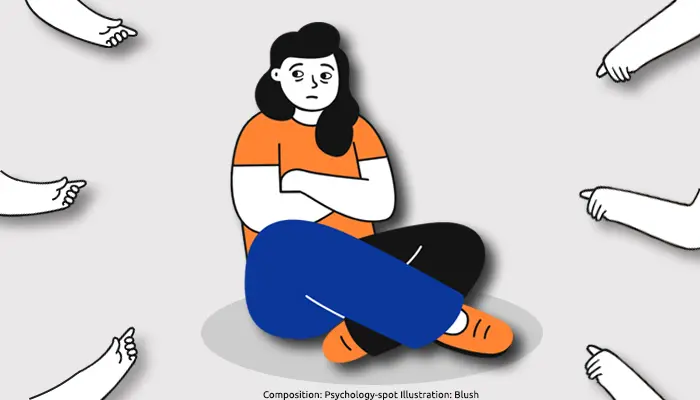
If you often feel responsible for the discomfort of those around you or think that if someone doesn’t respond immediately to your message it’s because you’ve done something wrong, you’re probably interpreting the world through “personalization bias”.
You have no proof, but you also have no doubt; so you conclude that it must have something to do with you. In fact, this cognitive distortion is so dangerous because it often disguises itself as emotional clarity: it makes you believe you are a perceptive, empathetic, and self-critical person, when in reality you are simply carrying responsibilities and blame that are not yours.
What exactly is Personalization Bias?
Personalization is a cognitive bias that denotes the tendency to automatically attribute the cause of external events to ourselves, especially when they are negative, even when there is no objective evidence that we are responsible. In other words, it consists of thinking that, in some way, we are responsible for everything that happens.
Let me clarify that everything that happens to us is personal, simply because it happened to us. But that doesn’t mean everything is our responsibility, much less that the world is conspiring against us. In other words, it raining on the day we had planned to go to the beach directly affects us, but that doesn’t mean the universe sent the rain to ruin our day.
In fact, personalization bias doesn’t necessarily imply being egocentric – or at least not in the classic sense. Most people who suffer from this cognitive distortion don’t think everything revolves around them from an inflated sense of self, but rather from a feeling of guilt or insecurity. The focus shifts to oneself, but tinged with self-accusation.
This reveals that at the root of this cognitive distortion lies a misattribution of blame or responsibility that disregards external factors and circumstances beyond our control. The blame becomes self-referential, unfairly directed inward.
Why are we so prone to personalization? The underlying psychological mechanism
Personalization bias does not appear by chance; it has deep roots.
On the one hand, our brains crave consistency. Uncertainty makes us extremely uncomfortable, so attributing causes (even incorrectly) reduces that anxiety. As a result, blaming ourselves or taking responsibility is, paradoxically, more reassuring than accepting that many things are beyond our control.
Basically, when our minds encounter gaps in information, they tend to fill them with a default hypothesis: “I am the problem.” We believe that if we are the cause, we could also be the solution. This feeling of control, even if fictitious, is psychologically more tolerable than accepting that the world is chaotic, that others have their own mental states, or that there are variables completely beyond our influence.
Personalizing offers a clear narrative, even if it is unfair to oneself.
On the other hand, personal history also plays a role. People who have grown up in highly critical, unpredictable, or emotionally demanding environments often develop a hyper-responsibility.
They learn to remain vigilant for any external signal that might be even remotely related to them in order to avoid conflict or rejection. In these cases, personalization bias becomes a survival strategy. The person believes that if they remain alert, anticipate, and assume blame beforehand, they might be able to avoid harm.
How to know if you’re personalizing (even if you don’t realize it)
Personalization bias is often subtle and disguised as automatic thoughts and emotional conclusions. That’s why it’s so difficult to detect: it doesn’t seem like a thinking error, but rather a “logical” interpretation of reality. However, some warning signs include:
1. You take responsibility for other people’s emotions
One of the clearest signs of personalization bias is assuming emotions that aren’t your own. If someone is serious, distant, or irritable, your first assumption isn’t that they’re having a bad day, are tired, or worried about something personal, but rather that you’ve done something wrong. The focus isn’t on what the other person is feeling, but on what you supposedly caused.
This pattern is often accompanied by constant monitoring of other people’s emotional states. You’re attentive to gestures, tone of voice, silences, or changes in attitude, and any variation is interpreted as self-accusation. As a result, you begin to live in emotional mode, trying to adjust your behavior to regulate other people’s moods, something that is neither possible nor healthy.
2. You read between the lines systematically… and almost always in the negative
When there’s ambiguity, your mind doesn’t just stop at “I don’t know.” It goes a step further and fills in the gaps, almost always with an interpretation unfavorable to you. A brief message becomes coldness, a delayed response becomes disinterest, and a neutral comment becomes veiled criticism that you replay endlessly in your mind.
That habit of reading between the lines and blaming yourself isn’t intuition, but a bias, because you don’t consider other possible interpretations. Instead, you assume you’ve grasped the hidden meaning, when in reality you’re just projecting your insecurities. Where there isn’t enough information, your mind introduces reproach, disappointment, or rejection. And it does so so naturally that you struggle to distinguish your interpretation from reality.
3. You explain the facts with very little information
Another common sign is how quickly you jump to conclusions. You don’t ask questions, you don’t compare notes, you don’t verify anything. A single detail is enough for you to construct a complete explanation, usually focused on your supposed mistake or flaw. Basically, your mind acts like a judge passing judgment without hearing the defense.
This type of reasoning saves cognitive effort, but it comes at a high emotional cost. By not testing your hypotheses, you reinforce an internal narrative that repeats itself over and over: something is wrong with me. Over time, these hasty conclusions become entrenched beliefs that you don’t question even when the evidence points in another direction.
In short, a good indicator of personalization bias is this: if your emotional reaction to a neutral or ambiguous event is disproportionate, especially in the form of guilt, shame, or self-criticism, it’s very likely that you’re not reacting to the event itself, but to the story your mind has constructed about it. And that story almost always places you at the center of the problem.
The psychological consequences of living by personalizing
Habitual personalization isn’t just a particular way of interpreting reality; it’s a way of relating to yourself and others that takes a heavy toll in the long run. At first, it might seem harmless or even a sign of sensitivity or emotional responsibility, but over time it leaves a deep mark on how you perceive yourself, make decisions, and interact with others.
One of the first consequences is a decline in self-esteem. When everything negative that happens around you seems to be about you, the internal message is: something is wrong with me. You don’t even need anyone to criticize you because you’re already doing it to yourself.
Added to this is an emotionally demanding environment that’s difficult to sustain. If you believe your behavior directly influences the emotional state of others, you begin to measure every word, every gesture, and every decision. But living like this means always being on guard, anticipating reactions, correcting yourself even before you’ve made a mistake. This, obviously, leads to mental exhaustion.
Another common consequence is the development of relationship anxiety. Interactions cease to be spontaneous and become constant evaluation scenarios. Did I say too much? Did I offend them? Did they take that comment the wrong way? You mentally replay conversations, searching for mistakes that confirm your suspicions.
In fact, personalization fuels rumination. The more you take responsibility for what happens externally, the more you dwell on the same ideas and situations, trying to understand what you did wrong or what you should have done differently. This loop doesn’t lead to solutions, but rather to progressive burnout, and it has been directly linked to higher levels of anxiety and depressive symptoms.
Over time, all of this can lead to a feeling of overwhelming responsibility in life. In other words, you feel you have to manage emotional climates, anticipate problems, and mitigate tensions that aren’t yours to bear. This invisible burden often goes unnoticed from the outside, but internally it generates a lot of exhaustion, frustration, and often a vague sense of inadequacy.
How to deactivate personalization bias? 3 effective psychological techniques
The good news is that cognitive biases are not a curse, but mental habits that can be changed.
1. Mental rehearsal of positive and neutral alternatives
It’s not about thinking positively, but about thinking in terms of the plural. Every time your mind moves toward a personalized interpretation, ask yourself: “What other explanations are there?”
Force yourself to generate at least three alternative explanations that don’t include you as the main cause. For example, if someone doesn’t respond to your message, you can look for alternatives such as:
- “He’s busy and can’t answer right now”
- “Perhaps he’s stressed about something personal”
- “My message wasn’t lost, it just arrived later”
With practice, your brain will begin to consider these alternatives automatically, reducing the tendency to continually blame yourself.
2. Difference between responsibility and influence
One of the subtlest pitfalls of personalization bias is confusing influence with responsibility. Not everything that happens around you concerns you or depends directly on you, even if you are present. Understanding these distinctions is key when it comes to taking responsibility.
- Causing. You are the direct source of an event. For example, spilling coffee on someone’s shirt. In that case, there is full responsibility, even if you didn’t do it on purpose.
- Influencing. Your behavior contributes partially or indirectly. For example, you propose a plan and someone feels excluded. You may have played a role, but you are not entirely responsible for how the other person interprets it and feels.
- Coinciding. These are events that simply happen while you are present. For example, you are in a work meeting and two colleagues argue.
Recognizing these differences will free you from an unnecessary emotional burden.
3. Behavioral verification
A mind prone to personalization often draws conclusions without sufficient information, causing anxiety. Behavioral verification involves gathering objective data before assuming blame or imagining motives.
- Observe the facts. Identify exactly what happened, without adding interpretations. For example, stating that “My colleague didn’t greet me” is a fact; but thinking that “He’s ignoring me because he hates me” is an interpretation.
- Ask whenever possible. A brief question can clear up many doubts. A simple “Is everything alright? ” or “Have you had a bad day?” will allow you to check if your perception matches reality.
- Separate evidence from assumption. Before making a judgment, make sure there is concrete data to support it. Remember that the absence of information is not proof of guilt.
By comparing your thoughts with reality, the intensity of guilt, anxiety, and rumination decreases. With practice, behavioral checking will become a habit that acts as an automatic filter: before assuming everything applies to you, your mind first verifies the facts.
Finally, remember that personalization bias isn’t about selfishness or egocentrism, but about a mind that has learned to be overly vigilant and excessively self-blaming. When you deactivate this bias, you understand that not everything is about you. Sometimes, inner peace begins simply when you stop taking on responsibilities and blame that aren’t yours.
References:
Kuru, E. et. Al. (2018) Cognitive distortions in patients with social anxiety disorder: Comparison of a clinical group and healthy controls. European Journal of Psychiatry; 32(2): 97-104.
Blake, E. et. Al. (2016) The relationship between depression severity and cognitive errors. American Journal of Psychotherapy; 70: 203-221.




Leave a Reply