Updated: 24/10/2025 por Jennifer Delgado | Published: 09/09/2025
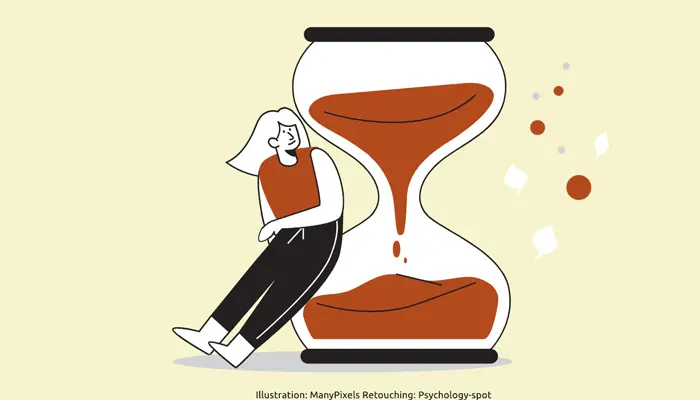
It’s happened to us all: we promise it’ll only take 5 minutes, but then, as if by magic, the clock seems to speed up, and suddenly half an hour has passed. It happens all the time: when we’re estimating how much time we have left until we finish our report, when we’re ready to go, when we have to make a quick purchase, or when we finish reading our messages on our phone.
This inability to accurately estimate how long it will take has a name: the planning fallacy.
What is the planning fallacy?
The planning fallacy is the tendency to underestimate the time required to complete a task. And it’s not just limited to the email you need to send or how long it will take you to be ready to leave the house. It’s constantly evident at all levels.
In 1994, psychologists at Wilfrid Laurier University, the University of British Columbia, and Waterloo University asked students to estimate how long it would take them to complete their thesis projects. They found that the average estimated completion time was 33.9 days, which was 21.7 days less than the actual average completion time. In other words, it took them almost twice as long as they had initially estimated.
The planning fallacy also explains why major projects, from home renovations to software releases to construction plans, consistently go over budget and fall behind schedule.
Construction on Berlin-Brandenburg International Airport, for example, was estimated to take five years but ultimately took 14. The Sydney Opera House, planned for four years, took 14. And the Sagrada Familia, which was originally intended to take a few decades, has been under construction for over 140 years and is still not finished.
What is the reason for this bias?
The planning fallacy goes far beyond poor time management. The problem is that when we plan, we focus on the task at hand, ignoring all the interruptions and complications that often arise along the way.
In other words, we only consider writing an email, finishing reading a message, or purchasing a product. We don’t consider other urgent emails arriving, ten incoming notifications catching our attention, or finding a long line at the checkout.
In part, this is because we tend to make overly optimistic estimates, thinking everything will go smoothly. We forget that we’re exposed to a thousand potential setbacks that can play tricks on us, multiplying the initial time. This leads to extremely unrealistic expectations.
We imagine the future from an idealized version of ourselves, one in which we are highly efficient and do things focused and uninterrupted. We (conveniently) ignore distractions, unexpected events, or even things like our energy and motivation levels.
This positivity bias is often also combined with selective memory. That is, when we look back to make our estimates, we remember more about how we wanted things to turn out than how they actually turned out. If yesterday you were only going to check a couple of emails and ended up answering every single one in your inbox an hour later, today you’ll probably ignore that and think, “This time, it’ll only take 5 minutes.”
How to avoid the planning fallacy?
Systematically underestimating the time we need to do things creates a chain of disastrous consequences, from stress to the constant feeling of running out of time. This can fuel frustration, stress, irritability, and anxiety.
It’s also common for us to plan more than we can actually fit into a day and to demand more of ourselves than we’re capable of delivering, which leads to constantly overcrowded days and unfulfilled promises.
In fact, the planning fallacy also affects our credibility. When we consistently miss deadlines, we lose confidence in our organizational skills, which reduces motivation and undermines our self-esteem. At the same time, others trust us less and less.
In this regard, there’s good news and bad news. We can’t completely eliminate the planning fallacy, but we can prevent it from getting completely out of hand with these strategies.
1. Add a little more to your estimate, just in case
A simple but powerful technique is to take your initial estimate, multiply it by two… and then add a little more. If you think it will take 5 minutes, it’ll probably take 15. If you think you can do that job in 3 hours, estimate 6 instead.
It’s not about distrusting your abilities, but rather about correcting the excessive optimism to which we so often fall prey. In fact, many professional project managers systematically apply this rule to gain a little time and avoid generating unrealistic expectations.
2. Include margins of error
Murphy’s Law says that “anything that can go wrong, will.” It’s not being pessimistic; it’s called strategic negativism. Always leave room for setbacks and unforeseen events. If they don’t happen, so much the better. But if they do, you won’t be up to your neck in water.
Schedules that are planned down to the last detail are doomed to failure. If you don’t leave space between tasks, every small deviation will accumulate and eventually overwhelm you. It’s advisable to leave at least 20-30% of your workday unassigned, as a buffer for the unexpected and emergencies. Don’t think of it as “lost” time, but rather as a buffer time.
3. Take an external perspective
Instead of thinking about how long it will take you to complete a task, think about how long it might take someone else. This shift in perspective will prevent your ego from taking over and setting arbitrary deadlines that are too tight.
Ask yourself: How long does it take others to complete similar tasks? Why do you think you’ll be faster? Think back to the last time you completed a similar task. How long did it take you? Try to answer objectively.
Last but not least, you may have to accept that you can’t do everything, and that’s okay. Part of the problem also comes from trying to fit more tasks into our schedule than actually fit into our day. We think we’re super productive, efficient, and fast… but in the end, we just end up frustrated, exhausted, or feeling like we’re always just getting there.
Learning to say “I don’t have time today” or “I need more time” isn’t giving up or being lazy, it’s managing your time and energy maturely and sensibly.
Source:
Buehler, R.; Griffin, D. & Ross, M. (1994) Exploring the ìPlanning Fallacy: Why People Underestimate Their Task Completion Times. Journal of Personality and Social Psychology ; 67(3): 366381.




Leave a Reply