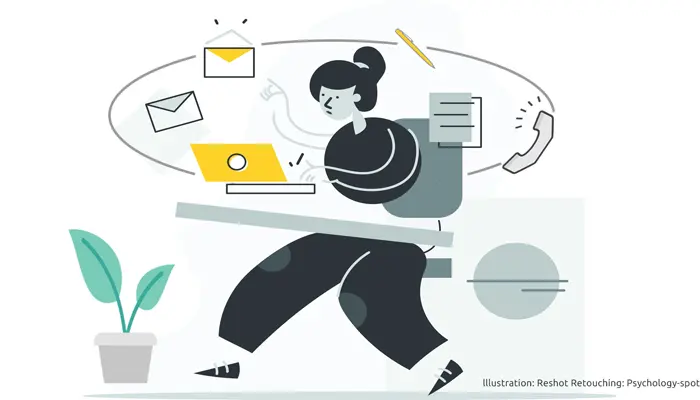
Acute stress is like that unwelcome guest who arrives unannounced and settles in your home for an indefinite period of time. A result of everyday demands and pressures, it can also arise as a result of situations that push us to our limits. And if we don’t address it, it can lead to acute stress disorder, which can significantly affect our well-being.
What exactly is acute stress?
Acute stress is the body’s immediate and specific response to a situation it perceives as threatening or challenging. This reaction is triggered when something pushes you out of your comfort zone, whether it’s an unexpected argument, an exam, a traffic jam just when you’re running late, bad news that affects you directly, or even one of those terrifying “can we talk?” texts.
From a physiological perspective, there’s a rapid activation of the hypothalamic-pituitary-adrenal axis, which releases adrenaline and cortisol to put you in “alert mode.” Your body doesn’t really distinguish between fleeing from a tiger or facing a project presentation, so it reacts the same way: your heart rate accelerates, muscle tension builds, your breathing becomes shallow, your pupils dilate, you start to sweat…
Obviously, this mechanism in itself isn’t bad, as it could help you survive in an emergency situation. The problem arises when this response becomes disproportionate, frequent, or too intense, as it becomes, contradictorily, an obstacle to dealing with the problem.
Acute stress symptoms: the symptoms you shouldn’t ignore
Acute stress isn’t simply “being stressed”; it’s being on full alert. Sometimes it lasts a few minutes, other times it can last for hours or even days. The important thing is to recognize it early so we can take action and avoid getting stuck in that loop. Some of the symptoms that indicate acute stress include:
Psychic symptoms
- Emotional overflow. You feel like everything is “too much.” There’s no mental bandwidth left to process things calmly.
- Racing or catastrophic thoughts. Your mind jumps to the worst-case scenario. What if this happens? What if I can’t handle this? What if everything falls apart?
- Disconnection or depersonalization. You may feel “outside of yourself,” as if you’re watching what’s happening to you from the outside or everything seems unreal.
- Difficulty thinking clearly. You lose the ability to reason logically. It’s as if your mind is “cloudy” or trapped in chaos.
- Emotional blockage. Sometimes, instead of exploding, acute stress “freezes” you emotionally. You can’t cry, speak, or react.
- A feeling of constant threat. The brain operates on high alert. It prepares for anything to go wrong at any moment, even in safe situations.
- Difficulty regulating emotions. You can go from crying to raging in seconds. Emotions overflow and spill out unfiltered.
- Irritability or hypersensitivity. You explode over the slightest thing. Everything bothers you, hurts you, and overwhelms you, even the smallest details.
- Intense fear or extreme anxiety. It’s not just worry; what you feel is a visceral anguish that paralyzes you.
- Need for control. You obsess over finding quick fixes, controlling the uncontrollable, or “doing something now,” even if you don’t quite know what.
Physical symptoms
- Palpitations or tachycardia. Your heart races, as if you’ve run a marathon.
- Short or shallow breathing. You feel short of breath, which increases when you try to breathe more deeply.
- Muscle tension. Your entire body goes into defense mode, preparing for “what’s coming”: you clench your jaw, your neck stiffens, and your shoulders tense.
- Excessive sweating. Acute stress stimulates the sweat glands, causing increased sweat production. You may experience clammy palms, cold sweats, or excessive perspiration.
- Nausea or upset stomach. The brain-gut axis is a two-way channel, so stress particularly affects the gastrointestinal system. You may feel your stomach tighten, a lump form in your throat, or the urge to vomit.
- An urgent need to escape or avoid the situation. Acute stress is a response to an overwhelming situation, so you may want to run away, hide, or shut down. Your body is telling you to “run away.”
- Insomnia or sudden awakenings. When you’re stressed, you have trouble sleeping or wake up in the middle of the night startled or with racing thoughts and worries running through your head.
- Involuntary tremors or jerks. The hands, legs or eyelids may tremble due to excessive activation of the nervous system.
When does acute stress disorder occur?
It is estimated that between 5-20% of people who experience trauma will eventually develop acute stress disorder. It is generally diagnosed when symptoms persist for more than three consecutive days, causing significant impairment in functioning:
- You constantly relive the traumatic event, whether through intrusive memories, images, nightmares, or the feeling that it is happening again.
- Intense anxiety or extreme distress. The feeling of imminent danger doesn’t go away. You experience disproportionate distress or panic, even though the event has passed.
- Dissociative symptoms. You feel like time slows down or you’re disconnected from your surroundings. You may see yourself from a stranger’s perspective or feel “out of your body.”
- You avoid everything related to the event, whether it be memories, thoughts, feelings, people, or places associated with the trauma.
- You suffer from a state of almost constant excitability that causes you trouble falling or staying asleep. You feel constantly irritable and have a hard time concentrating.
How to differentiate acute stress from acute stress disorder?
Acute stress is a normal response to a highly stressful situation. Although it can be very intense, its symptoms disappear on their own in a matter of hours or a few days, as soon as the event passes. For example, we may experience a peak of anxiety after receiving bad news, but we gradually calm down as we come to terms with what happened.
Acute stress disorder, on the other hand, usually appears after traumatic events perceived as a very serious threat. Its symptoms do not go away and significantly interfere with daily life. It can occur after a traffic accident, a mugging, an earthquake, or any other unexpected event that emotionally destabilizes us and poses a significant threat.

The 3 personality traits that increase stress
It’s a truism that stress doesn’t affect everyone equally. It’s also a truism that what may be stressful for some may not be as stressful for others. In fact, research has revealed that people with certain personality traits tend to react worse to stressful situations, making them more likely to develop acute stress disorder.
- High neuroticism. Neuroticism is characterized by high emotional instability and insecurity. Interestingly, people with this trait show a more restrained physiological response to stress, but report greater emotional distress and vulnerability.
- Low openness to experience. People who are not very open to trying new experiences also show a physiologically attenuated stress response. However, in challenging contexts, moderate activation is necessary to effectively cope with the situation. When this doesn’t occur, our ability to adapt decreases, causing us to perceive the experience as much more threatening, which increases stress.
- Low kindness. People who aren’t very agreeable also tend to have more difficulty dealing with stress. This is likely because many social situations become a source of tension due to their difficulty cooperating with others. However, it could also be because their way of relating to others limits their support network, which is often essential for dealing with particularly difficult situations in life.
How to deal with acute stress without getting overwhelmed? 5 strategies that work
When acute stress hits, everything becomes urgent, intense, and overwhelming. You feel like you can’t think clearly and the world is crashing down on you. But right then, when everything seems overwhelming, is when you most need practical resources to restore your balance. Learning not to get carried away isn’t a matter of strength, but of strategy.
1. Detect the first warning signs before reaching the point of no return
The first strategy for dealing with acute stress is as simple as it is powerful: detect that unwanted guest long before it moves into your home. It seems obvious, but many people don’t realize they’re stressed until they’re on the verge of a nervous breakdown or have their stomach in knots.
Developing body awareness by taking short breaks throughout the day to ask yourself, “How am I feeling right now?” for example, will help you identify those hidden symptoms of stress and stop it before it escalates and becomes more difficult to manage.
Do you notice yourself speaking faster? Do you have trouble taking a deep breath? Does everything bother you? Are you overreacting? These are signs that acute stress could be knocking at your door.
Also remember that acute stress feeds on inertia. If you don’t slow down, it becomes cyclical. Therefore, it’s helpful to create “micro-breaks” throughout the day, not only to check in, but also to slow down: 10 minutes without a screen, enjoying a cup of tea without doing anything else, looking out the window, listening to a relaxing song… This isn’t useless leisure time; it’s active prevention.
2. Breathe (yes, really)
Breathing is probably the most underrated tool on the planet. Breathing deeply and slowly not only “relaxes” you, but it literally tells your nervous system that the danger is now clear.
Breathing exercises have been shown to promote changes in the autonomic nervous system that directly influence heart rate and central nervous system activity. In fact, EEG studies show an increase in alpha waves and a decrease in theta power.
Neuroscientists have also observed that deep, slow breathing produces increased activity in cortical and subcortical structures, resulting in a state of greater comfort, relaxation, energy, and alertness while reducing symptoms of arousal, stress, anxiety, depression, anger, and confusion.
A simple technique to reap these benefits is to inhale for a count of 4 seconds, hold it for 4 seconds, and exhale slowly through your mouth for about 6 seconds. Repeat three times. This will activate your parasympathetic nervous system, which is basically your body’s parking brake.
3. Ground yourself
Acute stress often triggers thoughts like “What if everything goes wrong?” or makes you think anything is dangerous. To short-circuit it, you can use this quick technique:
- Look around and name 5 objects you see.
- Touch 4 things and notice their texture.
- Listen to 3 sounds.
- Smell 2 aromas.
- Try 1 thing (a chewing gum, a sip of water).
This grounding technique is particularly effective because it forces you out of your mind and anchors you in the present. Therefore, it’s helpful for stopping the spiral of worry and catastrophic thinking that stress often triggers.
It’s also an effective strategy for cutting through the emotional chaos that acute stress often unleashes. If something completely overwhelms you and you feel like you can’t even think about what to do next, breathe and ground yourself. It will help you regain control.
4. Question your thoughts – without self-deception
Acute stress can be caused by an external event, but it’s usually fueled by thoughts like, “This is terrible,” “I won’t be able to do it,” “If it doesn’t turn out perfectly, all is lost.” These are automatic, unrealistic thoughts that keep the alarm bells ringing in your brain.
The key isn’t to think positively or put on a brave face. It wouldn’t work even if you forced yourself to. The secret is to think more usefully.
Ask yourself:
- Is it as serious as it seems?
- What part is under my control?
- What would someone who loves me and sees me from the outside tell me?
You don’t need to become Buddha. You just need to question what your mind is telling you to gain a psychological distance that allows you to think more clearly.
5. Be more pragmatic than ever
When acute stress hits, it’s not the time to analyze everything or search for the whys and wherefores of everything. Your mental energy is at its limit, so pragmatism is your best ally. Ask yourself a single question: “What do I need to resolve right now, and what can wait? ” Leave the big decisions for later and focus only on what’s urgent and manageable.
Break the chaos down into small, concrete tasks. If you have a thousand things to do, choose one – the simplest or most important – and start there. Writing down what’s on your mind also helps: get rid of what you don’t need to process at the moment to lighten the mental load. And if you can’t handle everything, that’s okay. Tackling just one task is more than enough when you’re really stressed.
Stress won’t go away, but you can tame it
Stress isn’t going to disappear from your life. It’s part of the human condition. But you can learn to listen to it, understand it, and respond in a way that doesn’t harm you.
You don’t even need to become a Zen monk to regain control. Just recognize when something is overwhelming you and give yourself permission to do things differently or simply take a break.
The more you understand yourself, the more tools you’ll have to deal with acute stress, rather than letting it drag you down. Research has shown that the best way to deal with stress is precisely to develop stress tolerance.
In the end, it’s not about eliminating stress, but rather learning to live with life’s ups and downs. And that, like all truly valuable skills, takes practice. One, two, stress… breathe.
References:
Zaccaro, A. et. Al. (2018) How Breath-Control Can Change Your Life: A Systematic Review on Psycho-Physiological Correlates of Slow Breathing. Front. Hum. Neurosci.; 12: 10.3389.
Bryant, R. A. (2018) The Current Evidence for Acute Stress Disorder. Curr Psychiatry Rep; 20(12): 111.
Xin, Y. et. Al. (2017) The relationship between personality and the response to acute psychological stress. Sci Rep; 7: 16906.
Bibbey, A. et. Al. (2013) Personality and physiological reactions to acute psychological stress. International Journal of Psychophysiology; 90(1): 28-36.
Ponniah, K. & Hollon, S. D. (2009) Empirically supported psychological treatments for adult acute stress disorder and posttraumatic stress disorder: a review. Depression and Anxiety; 2 6(12): 1086-1089.