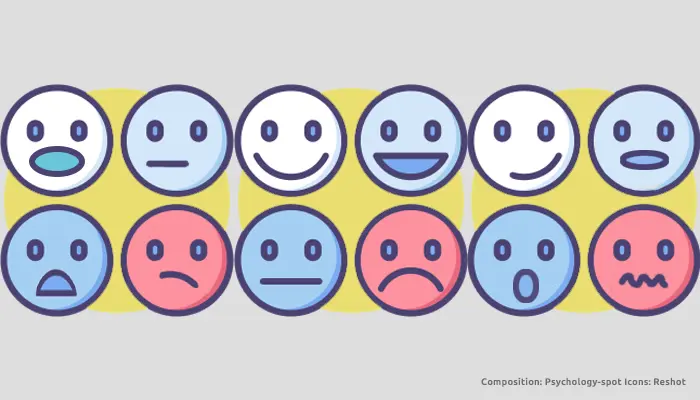
I’m furious, so I can yell at you.
I feel sad, so I can disappear.
I feel frustrated, so I might break something…
In an era that celebrates authenticity, it’s important to remember that there’s a huge difference between what you feel and what you do with it. Assuming that emotions give us carte blanche to do whatever we want in the name of “naturalness” can have disastrous consequences for relationships, work life, and mental health.
All emotions are acceptable., but not all behaviors.
Unfiltered expression is not freedom, it is blowing off steam
In recent years, “emotional authenticity” has begun to be glorified, as if everything we feel should be expressed as it is, without nuance. Motivational slogans like “say what you feel” or “be yourself” printed on mugs, notebooks , and even paintings have contributed to a simplistic and even immature view of emotional health that confuses spontaneity with impulsiveness.
However, unregulated emotional expression isn’t necessarily healthy. It may provide momentary and even cathartic relief, but it often comes at a high long-term cost. And often, instead of resolving the underlying conflict or problem, it exacerbates it.
In fact, an experiment conducted at Ohio State University concluded that “doing nothing is the most effective strategy for relieving anger” than venting. Behind many behavioral outbursts isn’t just pent-up emotion, but a difficulty identifying, digesting, and tolerating it without having to spit it out.
Being emotionally authentic doesn’t mean being carried away by the emotion of the moment. It means recognizing our emotions and feelings, understanding their causes, and choosing how, when, and with whom to share them. That’s mindful authenticity.
Emotions are not chosen
Emotions aren’t chosen on the menu. We can’t choose what we feel. No one chooses to feel jealous, sad, guilty, or angry. Emotions are usually a reaction to what happens to us, colored by how we perceive it and the meaning we attribute to it. Sometimes they are expressed clearly, other times as an echo of something unsaid, unheeded, or misunderstood.
In any case, they serve an adaptive function: they inform us of something. They’re like internal messages that the body and mind send us to let us know that something needs our attention.
Fear warns us that we should protect ourselves. Sadness calls us to retreat. Anger signals a boundary we’ve crossed. Even envy, so frowned upon socially, is a compass that can point to hidden desires.
Feeling isn’t a problem. The problem is not knowing how to express those emotions assertively and, therefore, allowing them to overwhelm us and potentially hurt us or others.
The fine line between what we feel and its behavioral expression
Feeling angry doesn’t justify insulting. Just as feeling sad doesn’t justify disappearing without explanation, and experiencing anxiety isn’t an excuse for mistreating others. It’s not about self-censorship or repressing what we feel, but about simple, pure affective responsibility.
Because we may not be able to choose how we feel, but our behaviors are in our control. We can learn to pause in conversation before exploding. To maintain psychological distance to avoid reaching the point of no return. To choose the right words to express ourselves without hurting others. In short, to take care of the how, without betraying the what.
Saying “I’m angry and I need space” isn’t the same as throwing an object against a wall, slamming a door, or verbally attacking someone. The former is assertive and mature communication. The latter is unbridled venting. And the difference isn’t just semantic; it often marks the dividing line between a mature relationship and a toxic one, whether with others or with oneself.
It’s not about hiding what you feel, but about giving it an appropriate outlet. Sometimes it might be writing. Other times, it might be talking. Other times, it might be simply taking a deep breath. And sometimes, simply acknowledging it in silence will suffice. The important thing is to prevent the emotion from becoming a justification for harming, manipulating, or overcoming it.
Emotions with rights, behaviors with limits
We must not forget that our actions have an impact and that others are not obligated to bear the consequences of our internal states. Anger may be legitimate, but aggression is not. Pain may be profound, but it does not justify blaming others. Fear may paralyze, but it does not give us carte blanche to abandon commitments without warning.
An emotionally mature society isn’t one where everyone expresses themselves without filters, but where emotions are validated and behaviors have clear limits. Because feeling is okay. But acting any way is not. And that nuance, that fine thread between the internal and the external, is what sustains coexistence, empathy , and mental health.
And this applies to both the intimate and the social: at home, on social media, at work, in politics… Emotional discourse can’t justify any action. Because emotion explains, but it doesn’t always excuse.
Accepting that all emotions are valid means recognizing a rich, complex, and authentic inner life. Transforming this emotional experience into responsible behaviors is what allows us to live together, nurture our relationships, and grow as people capable of controlling ourselves and doing something positive with what we feel instead of simply being swept away by it.
Source:
Bushman, BJ (2002) Does venting anger feed or extinguish the flame? Catharsis, rumination, distraction, anger and aggressive responding. Personality and Social Psychology Bulletin ; 28(6): 724–731.