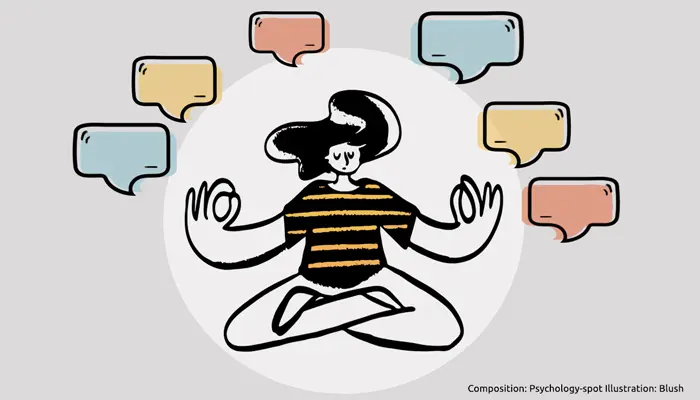
What if true intelligence didn’t begin with critical thinking but with critical ignorance? We tend to think that ignoring implies a passive attitude associated with mental laziness, but in reality it’s an active verb, a decision that pushes us to disregard what we believe doesn’t deserve our attention.
In a world that constantly bombards us with information and misinformation, stimuli and opinions of all kinds, learning to say “I’m not interested” or simply ignore certain things becomes almost an act of intellectual survival.
Critical ignorance could be a kind of “mental superpower” for surviving (and thinking better) in an era where everything demands our attention. Consciously ignoring allows us to filter out the irrelevant, protect our attention, and prevent the saturation of irrelevant information from paralyzing us or pushing us to react automatically.
What exactly is critical ignorance?
The concept of critical ignorance emerged in connection with the digital literacy environment. Sam Wineburg proposed that we should develop the ability to critically ignore; that is, to “Choose what to ignore, learn to resist low-quality and misleading, but cognitively attractive, information, and decide where to invest our limited attention span.”
Therefore, critical ignorance involves selectively filtering and blocking information to control our information environment and reduce exposure to false and/or low-quality data. Ultimately, cultivating critical ignorance is:
- One way to control the information that accesses our minds, and
- A conscious choice about what is worth thinking about.
However, critical ignorance isn’t limited to news headlines predicting the end of the world or social media posts specifically designed to anger us without any basis in reality. It also extends to the criticism we receive, unsolicited advice, the judgments of others, and even societal expectations.
Not everything that catches your eye deserves your attention
Our brain, particularly the emotional part, is calibrated to quickly detect what seems urgent or threatening. This mechanism, useful for survival in nature, has become a magnet that pulls us toward stimuli that probably have no relevance to our lives.
Thus, a completely misplaced criticism, an alarmist news story, or the opinion of someone we don’t even know ends up activating the same circuits that previously alerted us to a real danger. The result? They hijack our attention and stress us out as if they were a matter of life or death, even though they aren’t.
Our brains don’t easily distinguish between what’s important and what’s merely eye-catching. Whatever triggers an emotional response tends to occupy more mental bandwidth – even if it doesn’t deserve that space.
That’s why posts designed to shock or outrage go viral. A sensational headline captures our attention much faster than a neutral news story. We tend to pay more attention to the negative because, evolutionarily, that’s what we needed to detect first. However, just because something is emotionally loud doesn’t mean it’s significant.
A similar phenomenon occurs with criticism. When someone points out a flaw, however small or irrelevant, our brain interprets it as a threat. Being accepted by the group has always been essential for survival, so we are “wired” to react to any signal that suggests social rejection.
That internal alarm causes an isolated opinion or an unfounded comment to become a disproportionate focus of attention. The emotion – that twinge of shame, anger, or insecurity – is triggered and fixes those words in our minds for far longer than they deserve.
The problem is that letting yourself be swept away by everything that awakens emotions ends up fragmenting your attention, exhausting your mental energy, and distancing you from what really matters.
The enormous importance of blocking out the inconsequential
Attention is our scarcest resource, though we don’t usually treat it as such. Daniel Goleman warned that without attention we lose our capacity to think and make autonomous decisions. “Attention, in all its forms, is a mental asset that, despite being little recognized (and even underestimated at times), powerfully influences how we navigate life,” he stated.
Every time you get caught up in a pointless comment, a trivial argument, a useless notification, or destructive criticism, you’re saying “no thanks” to something that truly matters. When you overload yourself with trivial news, uninformed opinions, or malicious criticism, you lose the opportunity to focus on what’s really relevant.
Paying attention is like shining a flashlight: what you focus on becomes the main focus, but everything else remains in darkness. And often, it’s in that darkness where your true priorities remain.
Therefore, critical ignorance is not cognitive laziness but a form of mental self-care that allows you to focus on what truly matters. It’s understanding that you can’t attend to everything and that every “yes” you give to something has an invisible cost: an automatic “no” to something else. It’s preventing the irrelevant from stealing your clarity and energy.
The key is to remember that attention is a limited resource. In a world designed to capture our attention by manipulating us emotionally, we must learn to consciously focus on what can truly make a difference in our lives – and let go of the rest.
How to develop critical ignorance when everything demands your attention?
Critical ignorance can act as a kind of shield, protecting you from worldly noise and triviality. It doesn’t mean isolating yourself in a bubble, but rather learning to make discerning choices.
- Use a filter question. Before getting involved in something and giving it your full attention, ask yourself: “Is this relevant to my life, my values, or my decisions?” or “Can it offer me anything useful?” If the answer is “no,” ignore it. Just move on.
- Use the “attention delay.” When something triggers an intense emotion, whether it’s a post or a comment, wait 30-60 seconds before reacting. That time frame is enough to deactivate impulsiveness and consciously assess whether it deserves your attention.
- Set sensory boundaries. In a world full of stimuli, it’s difficult to shut out the noise. Therefore, it’s a good idea to silence some notifications, unfollow accounts or people who only create noise, set aside phone-free hours, and choose your information sources wisely. Fewer stimuli equals less emotional clutter.
- Accept that you don’t need to know everything. Constant connectivity has made us susceptible to FOMO (fear of missing out). This fuels the urge to read anything, comment, or react to something irrelevant. Instead, accept that you don’t need to know everything. Observe the noise and let it pass, like a cloud.
- Practice cognitive closure. You won’t always be able to tune out the noise. Sometimes a post, a review, or an opinion will grab you, probably because it’s struck a nerve. In that case, don’t blame yourself; simply close the matter mentally. Say to yourself, “That’s it. I’m not going to dwell on it anymore.” And move on to something more important.
Critical ignorance is a skill that, in the long run, not only brings mental clarity but also greater serenity in a world that wants to keep us focused on the trivial. When you choose what to ignore, you also choose the kind of life you want to lead. Ultimately, if you filter out all that noise, you won’t miss anything worthwhile; rather, you’ll regain something valuable: your attention.
References:
Lewandowsky, S. & Hertwig, R. (2025) Critical ignoring when information abundance is detrimental to democracy. Current Opinion in Psychology; 66: 102128.
Kozyreva, A., Wineburg, S., Lewandowsky, S., & Hertwig, R. (2022). Critical Ignoring as a Core Competence for Digital Citizens. Current Directions in Psychological Science , 32 (1), 81-88.




Leave a Reply