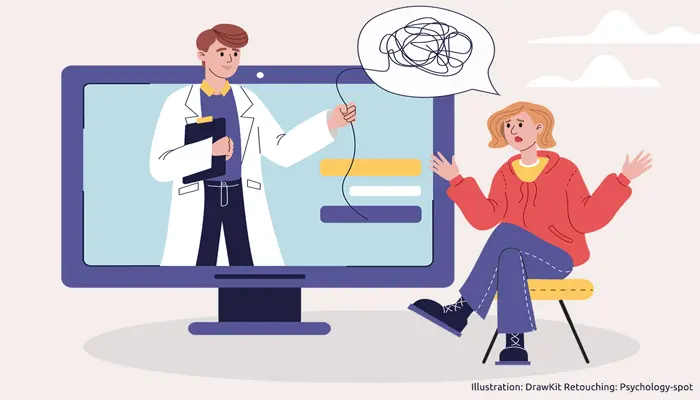
Taking care of your mental health has never been more urgent or accessible. We live in a time when stress, anxiety, and depression affect millions of people around the world, and technology has become an unexpected ally in addressing these problems.
Online consultations have ceased to be a secondary alternative and have become an essential tool that brings psychiatry to more patients, breaks down geographical barriers, and reduces the stigma surrounding seeking help. Therefore, it’s worth exploring their journey and analyzing how they’re changing the way we ask for and receive support.
The digital revolution reaches mental health
Over the past ten years, we’ve witnessed a radical change in the way society understands and cares for mental health. We’re now more aware of the importance of listening to our emotions and seeking professional help when we need it.
On the other hand, digitalization, far from being limited to commerce or leisure, has fully penetrated the healthcare sector. However, the turning point came during the first year of the COVID-19 pandemic, when depression and anxiety disorders increased by 25%, according to the World Health Organization. This meant that millions of people needed specialized help, forcing overwhelmed healthcare systems to find quick and effective solutions.
It was then that online care, which already existed but was almost incidental, became a priority. It not only served to provide continuity to ongoing treatments, but also to bring psychiatry closer to those who had never before dared to seek help.
In Spain, for example, during the lockdown, several autonomous communities launched telepsychiatry programs in public hospitals. Many healthcare centers increased their virtual consultations. In fact, in 2020, one in five patients accessed online health services, according to the INE (National Institute of Statistics and Census).
Online psychiatry, a response to new needs
Telepsychiatry emerged decades ago in rural areas of the United States and Australia, where long distances prevented access to specialists. In 1959, the Norfolk Hospital Psychiatric Institute in Nebraska was using wired videoconferences to conduct group therapy, provide long-term follow-up , and offer liaison psychiatry.
Today, that same logic applies to a hyperconnected world that has to deal with other barriers: impossible schedules, fear of stigma, lack of resources in public health, or a shortage of professionals in certain regions.
In this regard, a report from the American Psychiatric Association indicated that 81% of psychiatrists continue to see many of their patients through online consultations and plan to continue. Not only for convenience, but because they have found that many patients, especially young people and working adults, feel more motivated to continue treatment when offered digital flexibility. Ninety% of these professionals indicated that their patients are satisfied receiving treatment from home.
In parallel, online mental health platforms also grew exponentially during the pandemic. BetterHelp and Talkspace, for example, reported user increases of more than 60% between 2020 and 2021. Although the American model is not identical to the European one, it marks a global trend: digital care is here to stay.
Advantages of consulting with a psychiatrist online
Online psychiatry has ceased to be an “emergency” option and has become an effective option in mental health care. Beyond convenience, remote treatment has demonstrated concrete benefits:
- Greater accessibility. Online consultations significantly reduce wait times, especially in areas with a shortage of specialists. In Spain, regions such as Castilla-La Mancha and Extremadura have seen patients who previously waited months for an in-person appointment now see a specialist within weeks. This can make a difference in conditions where early intervention is crucial.
- Reducing stigma. Despite all the progress we’ve made in mental health, many people still feel anxious or vulnerable about seeing a psychiatrist. However, being able to speak with these professionals from home, in a safe and familiar environment, helps overcome this psychological barrier and allows more people to seek help when they need it.
- Treatment adherence. Continuity is key for most psychiatric disorders, whether to monitor the progression of symptoms and adjust medication or to avoid relapses and prevent complications that could lead to hospitalizations or acute crises. Fortunately, various studies have shown that physical distance does not compromise commitment to therapy. Online treatment typically generates the same therapeutic adherence as in-person consultations, and in some cases even more.
- Flexibility for patients and professionals. Online treatment allows the therapeutic relationship to be maintained even when changes of residence, travel, or complicated work situations occur. In practice, this means that a young university student in Malaga can have access to a leading psychiatrist in Madrid without having to travel, or that an expatriate worker in Brussels can continue seeing their specialist in Spain without interrupting therapy.
How to choose a good online psychiatrist?
The increase in digital offerings forces us to be cautious. Not everything presented as an “online consultation” meets the necessary guarantees. The key is to verify a few details:
- Make sure the professional is registered in your country. This way, you’ll know they have the proper training and accreditation to practice psychiatry, avoiding falling into unreliable hands. Having a qualified online psychiatrist will guarantee you personalized, safe care tailored to your needs.
- Check their experience in clinical psychiatry. Not all professionals have the same background. Choosing a psychiatrist with extensive clinical practice provides confidence and security in your treatment.
- Check that the platform is secure. The query must be made through a system that complies with Data’s Protection Laws of your area, which guarantees the confidentiality of the information you share.
- Seek out other patients’ opinions. Reviews or testimonials can give you an idea of the professional’s treatment, effectiveness, and reliability.
- Consider whether they collaborate with hospitals or universities. These types of connections are often a sign of prestige, ongoing development, and a high level of commitment to clinical and scientific practice.
- Request an initial exploratory appointment. Beyond titles, the therapeutic relationship depends on trust and empathy. An initial session will allow you to assess whether that connection exists.
What are the main challenges and limitations of online psychiatry?
Digital consultations are synonymous with accessibility and convenience, but not everything is perfect. Online psychiatry also faces significant challenges that should be taken into account to avoid overestimating its capabilities or developing false expectations.
- Psychiatric emergencies. Although a video call can be useful for follow-up, in critical situations such as suicide attempts, severe agitation, or intense psychotic episodes, online care is not sufficient. In these cases, in-person, hospital-based intervention is still essential because it has the necessary emergency resources, specialized personnel, and a safe environment for the patient.
- Nonverbal communication. In a face-to-face consultation, the psychiatrist can observe subtle details of the patient, such as posture, mannerisms, involuntary gestures, or even a slight tremor. On screen, many of these nuances are lost or go unnoticed. This doesn’t invalidate online therapy, but it does represent a challenge that must be managed.
- Digital divide. Not everyone finds it easy to connect or feels comfortable speaking through a screen. Older adults, patients with fewer financial resources, or those living in areas with poor connectivity may be excluded from this type of care.
Finally, it’s also important to consider the oversupply of commercial services.
The growth of platforms and websites that provide “online care” has also brought with it new risks, as it’s not always clear whether the services are provided by qualified professionals, whether data is protected, or whether clinical criteria are respected. In these cases, regulation and oversight are essential to protect patients and ensure that digital care meets the same quality standards as in-person care.
Trends in online psychiatry for the future
Looking ahead, several technological trends are setting the course and redefining psychiatry as we know it:
- Artificial intelligence applied to diagnosis. Researchers at Stanford University are developing AI tools that provide a more accurate picture of a person’s mental health and can identify those who need help, detecting depressive symptoms based on voice patterns, for example.
- Integration of self-care apps. Vall d’Hebron Hospital is testing mobile tools that allow patients to record their mood and share it in real time with their psychiatrist for more accurate treatment monitoring.
- Therapeutic virtual reality. Virtual reality is no longer just a video game: more and more clinical trials are exploring its usefulness in the field of mental health, particularly in the treatment of specific phobias and post-traumatic stress disorder. This technology opens the door to new forms of immersive therapy that complement traditional treatments.
- Hybrid models. It’s no longer a matter of choosing between in-person or remote consultations, but rather a combination of both formats according to each patient’s needs. A hybrid model allows, for example, an initial face-to-face diagnosis to strengthen the therapeutic relationship and continue with online follow-up sessions. This flexibility allows for personalized care, optimized resources, and guaranteed that the patient receives appropriate attention at each stage.
In short, technological advances are transforming the way we care for our mental health. Online psychiatry is proving to be an effective tool for breaking down geographical and social barriers, so there’s no doubt this model will have a long life and will continue to evolve alongside the digital world.
References:
Bai, N. (2024) Going beyond ‘How often do you feel blue? Stanford Medicine Magazine; 1.
Leiz, M. Et. Al. (2022) Telemedicine as a Tool to Improve Medicine Adherence in Patients with Affective Disorders – A Systematic Literature Review. Patient Prefer Adherence; 16: 3441-3463.
Retolaza, A. (2021) Sobre Telepsiquiatría. Norte de salud mental; XVII(64): 76-81.
(2021) Psychiatrists Use of Telepsychiatry During COVID-19 Public Health Emergency Survey Results. In: APA.
Ayala-Servín, N. (2021) La telepsiquiatría: una revolución de la salud mental en tiempos de pandemia. Medicina Clínica y Social; 5(2):57-58.
(2020) La salud mental en la pandemia.Lo que dicen las encuestas. In: INE.
Fuhr, C. et. Al. (2018) The association between adherence and outcome in an Internet intervention for depression. Journal of Affective Disorders; 229: 443-449.