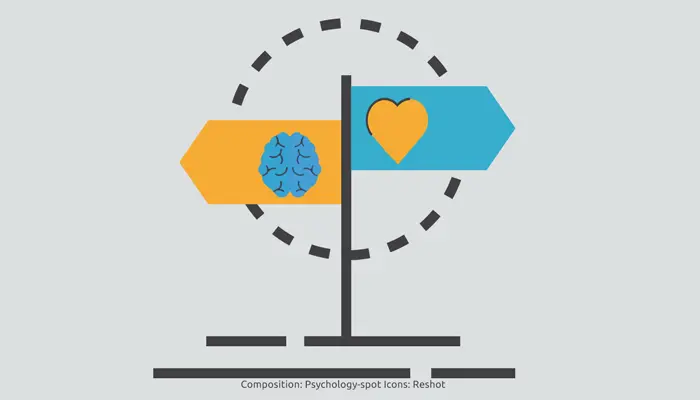
Every day we make a ton of decisions. And when I say a ton, I mean a ton (approximately 35,000 decisions). Fortunately, 99.74% of those decisions are made almost automatically, guided by our subconscious or the habits we’ve developed.
However, the remaining 0.26% are conscious decisions, the ones that give us headaches, distress us, and make us think about them over and over again. In fact, that 0.26% is enough to cause us significant stress and put us in a difficult situation.
The real reason we have such a hard time making decisions
We often think we have a hard time making decisions because the playing field is so level. That is, the pros and cons are so balanced that nothing tips the scales one way or the other.
This lack of clarity creates ambivalence. Our mind goes into a loop. We see the good and bad of each option, so we fall into a constant internal debate. One part says, “This is good for you,” and the other warns, “But so is this other one.” And so we go around in circles, unable to decide. We fall into what is known as analysis paralysis .
Of course, deciding whether to change jobs or cities isn’t exactly a piece of cake. Neither is ending a long-term relationship or committing to someone. In those cases, it’s not simply a matter of choosing between A or B, but rather of accepting the emotional consequences that come with what we’re leaving behind and what we’re going to do from now on.
However, the real stress comes not from the dilemma, but from the way we view decisions. If we perceive a choice as final, like a door that closes forever, it’s natural to feel enormous pressure to “make sure we don’t make mistakes.”
From that perspective, making a decision becomes a kind of “exam” with no chance of recovery, a one-way street with no turning back. And of course, when we feel that enormous weight on our shoulders, it’s easier to remain motionless, staring at the fork, than to dare to take a step.
The solution? Changing your perception of decisions
The real secret to making decisions without stressing yourself out is to remember that very few decisions are truly irreversible. Except in extreme cases or tragic decisions (which, fortunately, we don’t make every day), the truth is that life gives us a much wider margin than we think to adjust, correct, or even retrace the path we’ve already taken.
Most of the decisions we make in life allow us to reverse course, or at least correct our course. Think about it for a moment: How many times have you made a decision that you later changed? A job that seemed permanent but you left. A move that you reversed. A relationship that once seemed “forever” has since had an expiration date.
And it wasn’t the end of the world.
Changing your mind, taking a new direction, or recognizing that “this wasn’t what I thought” isn’t a failure; it’s part of the process of living consciously. In fact, you often can’t know if something is right for you until you try it. Clarity doesn’t always come before the decision; sometimes it appears after it’s been made. Sometimes, choosing one path helps you realize it’s not the one you wanted and embark on another with greater conviction.
This shift in perspective is extremely powerful because it takes the drama out of the act of choosing. It’s not about taking important decisions lightly, but rather about breaking away from that rigid logic in which every decision seems like a definitive judgment. It’s about letting go of the idea that if you choose wrong, you’ll ruin everything or that it’s the beginning of disaster.
It will also help you understand that every decision, even the most important ones, is based on many other choices that you can change at any time. You can change your mind. You can change your priorities. You can change your desires. In fact, it’s perfectly normal. Change is also a sign of growth and emotional maturity.
Making decisions from this more flexible perspective will allow you to move beyond the “all or nothing” mindset and into the realm of real decisions, those made with what you know and feel today. With the humility to accept that tomorrow, you may have new information or other feelings that will make you change.
So, if you have a hard time making decisions and don’t dare to take a step forward for fear of making a mistake, remember that you’re not signing an eternal contract. You’re choosing a path. And if you later discover it’s not the one you want, you can reconsider. Ultimately, that’s what living is all about: fine-tuning your course as you go.
References:
Chen, C. Y. et. Al. (2018) Feeling Distressed From Making Decisions: Assessors’ Need to Be Right. Journal of Personality and Social Psychology; 115(4), 743-761.
Moseley, H. (2017) New research highlights the unlocked potential of the human brain. Lightspeed Research & Huawei.