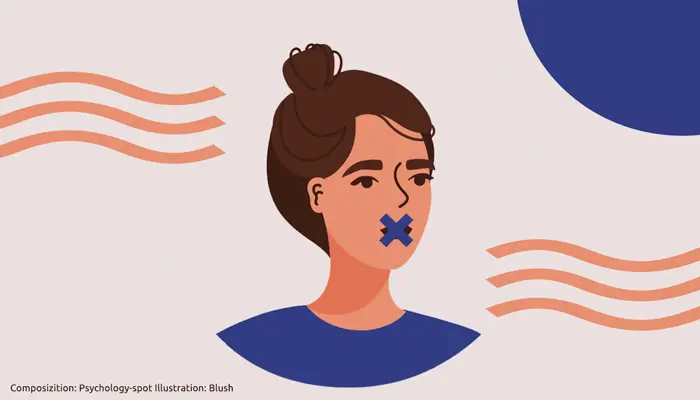
Have you ever said something in a moment of anger or frustration and, a minute later, wanted to eat your words? It’s happened to all of us (yes, even psychologists).
It may have been an unfortunate remark born of frustration, an unfair recrimination in the heat of an argument, or a devastating generalization in a moment of sadness or distress. Verbal impulsiveness is one of our enemies.
The outrage that we later regretted
Impulsiveness is an automatic brain mechanism. When we feel attacked, frustrated, or nervous, our limbic system (the emotional part of the brain) activates and takes over. The prefrontal cortex, the area responsible for reasoning and impulse control, temporarily takes a back seat. It suffers what is known as an “emotional hijacking.” In other words, we speak first, we think later.
When we’re too emotionally involved, our perception narrows: we see threats where there are none, we exaggerate other people’s mistakes, and sarcasm slips out, which we wield like a sword in self-defense. The next day, or even the next minute, the phrase we uttered seems ridiculous or even hurtful.
If we add daily stress and fatigue to emotional intensity, it becomes even more likely that we will say things we later regret, simply because it is harder to restrain ourselves in order to respond thoughtfully and calmly.
In that state, our brain has fewer resources available to consider the consequences of our words. This is confirmed by research conducted at Kyushu University, which found that intense emotional states do indeed lead to less activation of the prefrontal cortex, pushing us to act impulsively.
The danger of words spoken in the heat of the moment
The consequences of these verbal outbursts are twofold. On the one hand, we can hurt others, sometimes quite deeply. On the other hand, we damage our relationships, sometimes irreversibly.
Spoken words cannot be erased, making it very difficult to retract them. We can apologize, but the wound inflicted by a hurtful remark can be seared into our memories and often festers in subsequent arguments, resurfacing as recriminations, resentment, or mistrust.
Furthermore, verbal impulsiveness often creates a snowball effect that’s very difficult to control. When we say something unpleasant, the other person defends themselves, and we go on the attack again. As a result, what could have been a minor disagreement ends up becoming an argument of epic proportions.
A study conducted at the University of St Andrews confirms this, showing that increased negative emotions raise the likelihood of verbal impulsivity, which in turn triggers a defensive response in the other person. And all because of not taking a few seconds to breathe before speaking.
Therefore, speaking without filtering can cause arguments to escalate and lead to emotional wounds that are difficult to heal. And this doesn’t just happen in romantic relationships, but also at work, with friends, and within families.
How to control verbal impulsiveness with a simple question?
There are countless psychological techniques for controlling anger and impulsiveness, from creating emotional distance by using “time out” to trying to become an external observer. However, when things are about to spiral out of control, there’s a simpler and more effective shortcut: stop and ask yourself, “Would I say this if I were calm?”
- Pause and breathe. It sounds simple, but taking a deep breath before responding gives your prefrontal cortex the time it needs to regain control. Even a couple of seconds can make a big difference because they calm the brain and reduce impulsivity.
- Mentally rehearse what you’re going to say. Before speaking, repeat in your mind what you’re about to say and ask yourself honestly, “Could I repeat that tomorrow when I’m calm?” If the answer is no, it’s best to rephrase it.
It’s not about becoming Tibetan monks or silencing all our thoughts, but rather about learning to respond instead of reacting, choosing our words more carefully and being aware of their impact. In the long run, this will translate into greater equanimity and inner peace, making it a truly worthwhile change.
References:
McCurry, A.G. et. Al. (2024) Both partners’ negative emotion drives aggression during couples’ conflict. Commun Psychol; 2(73): 10.1038.
Sohn, J. H. et. Al. (2015) Effect of emotional arousal on inter-temporal decision-making: an fMRI study. J Physiol Anthropol; 34(8): 10.1186.




Leave a Reply