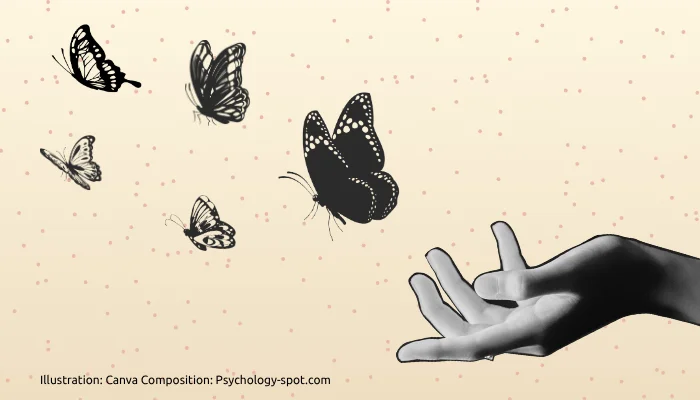
Lately, it seems everything can be resolved with one word: “letting go.” We have to let go of thoughts, emotions., jobs and even let go of people. Social media, mugs, cushions, and even the chalkboards in bars are full of phrases that repeat like a mantra: “let go,” “flow,” “don’t cling”…
But amidst all this emotional turmoil, it seems we’ve forgotten something essential: not everything that hurts should be let go, and not everything that weighs us down is superfluous. Perhaps this obsession with letting go is making us incapable of holding onto anything. Not the pain that helps us grow, not a rough patch, and certainly not a commitment, as psychologist Pepo Garrido warned.
It’s not detachment, it’s emotional escape
Few ideas have become as popular – and as misinterpreted – as that of “letting go.” What began as a basic principle of Buddhism and spread as a tool for emotional balance has become a strategy for not feeling too much. Not committing too much. Not thinking too much. Not living too much.
In Buddhism, attachment is considered a source of suffering, but only when we don’t know how to manage it and mistake it for control. In other words, it’s not attachment itself that harms us, but our inability to recognize that circumstances have changed and that we must adapt accordingly.
In the fast-paced, Western version of detachment, it has transformed into something else entirely: a sophisticated excuse for not getting too involved or for running away when things get tough. The current discourse of “letting go” has been absorbed by the culture of immediacy and instant gratification. Thus, we have ended up confusing the meaning of flowing and releasing with emotional escape.
And that also applies to relationships. In fact, sociologist Zygmunt Bauman coined the term “liquid modernity” to describe a society in which everything is transient: jobs, identities, and, above all, relationships. In liquid relationships, the goal isn’t so much to build as to experience. The important thing is that everything “flows,” and if it stops, it’s cut off at the root to move on to the next stage.
This relational model has generated a low tolerance for emotional frustration. When the other person doesn’t meet our expectations immediately, instead of trying to repair the relationship, we let them go. After all, it’s easier to change people than to resolve the conflict. But this logic turns relationships into products: we consume them, we don’t cultivate them.
The culture of instant gratification and the fear of holding onto what makes one uncomfortable
Behind the imperative to “let go” lies a market. Emotional well-being has become a multi-billion dollar industry overflowing with meditation apps, spiritual retreats, motivational coaching, and inspirational quotes on every product imaginable. All designed to encourage us to alleviate discomfort without actually experiencing it.
However, well-being isn’t about eliminating negativity, but rather about integrating all the emotions we experience. Studies on emotional diversity show that people who are able to experience a wide range of emotions, both positive and negative, have better mental health. Furthermore, researchers have also observed that suppressing or avoiding uncomfortable emotions is associated with higher levels of anxiety and lower life satisfaction.
Paradoxically, by obsessing over letting go of pain, we prolong it. Because what is avoided is not resolved: it lingers in the shadows, waiting for another opportunity to surface. And some processes don’t exist for us to simply discard, like an uncomfortable pebble in our shoe, but rather for us to experience. And in that difference lies a significant part of our emotional maturity.
Growing up in discomfort
The ability to endure hardship – without numbing or eliminating it – is one of the pillars of resilience. The psychiatrist Viktor Frankl explained that suffering can be a path to transformation, provided we face it with purpose.
However, the message of “letting go” pushes us in the exact opposite direction: to eliminate any discomfort before understanding it. In the name of a supposed “well-being,” we are creating an emotionally impatient and immature generation. People who confuse serenity with indifference and freedom with disconnection.
Going through what happens to us doesn’t mean getting stuck in pain or discomfort, but rather allowing ourselves to experience it without denying or avoiding it. It means understanding that discomfort also has a cycle, and that the only way out of it is by going through the middle.
We shouldn’t fight our emotions as if they were an enemy to be subdued, but rather learn to live with them. It’s not about letting go of the pain, but about giving it space. Letting it exist while we heal. Therefore, the problem isn’t wanting to let go, but doing it prematurely, too soon.
To mature emotionally, we need to learn to hold onto uncomfortable emotions without being swept away or trying to fight them off immediately. The ability to sustain something – whether it’s a project, a relationship, or grief – requires perseverance, even if it hurts, for a time.
Of course, this isn’t about accumulating pain or turning life into a masochistic exercise in endurance, but about regaining the ability to move through what hurts without giving in to the desire to immediately eliminate what bothers and upsets us. Emotional maturity isn’t measured solely by how many things you manage to let go of, but by how many you are able to hold onto without losing yourself in them.
References:
Quoidbach, J. et. Al. (2014) Emodiversity and the emotional ecosystem. Journal of Experimental Psychology: General; 143(6): 2057–2066.
Frankl, V. (1979) El hombre en busca de sentido. Editorial Herder: Barcelona.
Bauman, Z. (2003) Modernidad líquida. Fondo de Cultura Económica: Argentina.
Gross, J. J. & John, O. P. (2003) Individual differences in two emotion regulation processes: Implications for affect, relationships, and well-being. Journal of Personality and Social Psychology, 85(2), 348–362.




Leave a Reply